Finance · Markets
Philippine National Construction Holds $1 Billion Pasay Site Yet Generates Minimal Returns
State-controlled firm weighs exit from stock exchange as auditors flag underutilized prime real estate and unresolved government claims worth tens of billions of pesos
KEY TAKEAWAYS
- ·Philippine National Construction Corporation holds Pasay land appraised at 51.8 billion pesos yet earned only 290 million pesos in rental income during 2024, with auditors estimating foregone revenue exceeding 714 million pesos.
- ·The Commission on Audit issued an adverse opinion on the company's 2024 financial statements, citing unresolved government claims and liability disputes that could reach tens of billions of pesos.
- ·Confidential discussions about voluntary delisting from the Philippine Stock Exchange have stalled over concerns that the company's intrinsic value has not been adequately established for minority shareholders.
Underperforming Crown Jewel
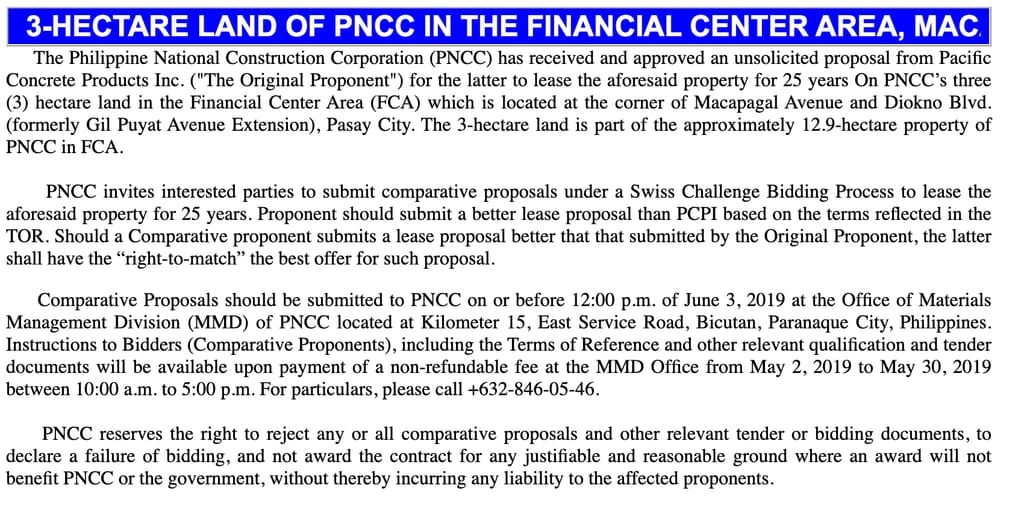
Philippine National Construction Corporation manages one of Metro Manila's most valuable land parcels, yet its financial returns tell a puzzling story. The state-controlled firm holds 129,548 square meters in Pasay City's Financial Center Area, independently appraised at 51.8 billion pesos in 2023. During 2024, that site delivered approximately 290 million pesos in rental income.
The Commission on Audit calculated foregone revenue exceeding 714 million pesos, noting that roughly three hectares operate under long-term lease while ten hectares remain idle or significantly underutilized. The discrepancy between appraised value and actual income generation sits at the center of a broader debate about how the company should be valued.
Confidential discussions have taken place regarding a voluntary departure from the Philippine Stock Exchange, according to a source with direct access to those conversations. No formal proposal has moved forward, in part because fundamental questions persist about how to calculate a fair exit price for minority investors when the company's true worth remains contested.
Real Estate Revaluation Pattern
PNCC's investment property portfolio has experienced dramatic appreciation over fifteen years. The Pasay holding was appraised at 6.6 billion pesos in 2009, climbing to 9.7 billion in 2013, then 32.4 billion in 2019, 35.7 billion in 2021, and 51.8 billion two years later. The company adopts fair-value accounting with biennial independent appraisals, meaning the figures on its balance sheet reflect current market assessments rather than historical purchase cost.
Total investment property carried on PNCC's 2024 audited statements reached approximately 54.5 billion pesos. That concentration in a single geographic corridor represents one of the largest commercial property exposures among Philippine-listed entities.
Yet title to the Financial Center Area remains registered under the Republic of the Philippines. Government legal opinions cited in company disclosures identify restrictions on sale, transfer, and development for portions of the site. Those constraints explain why a private developer has not pursued more aggressive monetization strategies.
Continuing Tollway Ties
Market perception holds that PNCC exited the expressway business entirely when operating rights transferred to private concessionaires. Financial statements reveal residual economic interests. The company continues to collect revenue shares and dividend income linked to legacy tollway arrangements involving the North Luzon Expressway and South Luzon Expressway.
These cash flows represent a fraction of the infrastructure's total value, but they confirm that PNCC retains contractual rights stemming from its historical franchise. Any valuation exercise must account for those streams, however modest, alongside the real estate portfolio.
Adverse Audit Opinion
The Commission on Audit issued an adverse opinion on PNCC's 2024 financial statements, flagging material disagreements over liability recognition. The principal dispute centers on obligations involving the Privatization and Management Office. PNCC contests the government's position; auditors maintain that liabilities are understated because accumulated interest and related charges have not been fully recorded.
Depending on resolution, the amounts in question could reach tens of billions of pesos. The outcome directly affects how much of the company's asset base ultimately accrues to shareholders versus satisfying government claims.
Valuation Complexity
The combination of high-value underutilized land, residual tollway economics, and unresolved government obligations creates a three-dimensional valuation challenge. Investors focusing solely on the 51.8-billion-peso appraisal overlook legal and accounting uncertainties. Those emphasizing the audit disputes ignore one of the country's premier commercial land banks.
Before any delisting proceeds, minority shareholders require clarity on whether the exit price reflects current earnings, appraised asset value, or a discounted figure accounting for contingent liabilities. The absence of consensus on those inputs explains why discussions have stalled.
What Comes Next
Whether PNCC remains on the exchange or eventually exits, the central issue is investor protection. A company holding prime Metro Manila real estate appraised at more than 50 billion pesos, yet generating returns below market expectations and facing material audit qualifications, cannot be fairly priced using standard multiples or comparable transactions.
The market now watches whether management and regulators will resolve the accounting disputes, clarify the legal status of the Pasay property, and establish a transparent framework for asset monetization. Until those steps occur, any proposal to take the company private will face legitimate questions about whether the offer adequately compensates shareholders for assets whose full value has yet to be realized.
PNCC represents a rare case in Southeast Asian equity markets where a listed entity combines government legacy infrastructure, prime urban land, and decades-old fiscal disputes. For investors, the lesson is clear: book value and market capitalization often diverge when underlying assets remain locked behind legal and regulatory complexity.
RELATED STORIES

PhilWeb Trading Halted After P4.2 Billion JKS Tech Bet
Tran Quoc Bao · 3 min

Manila Halts Approvals for Digital Payment Operators Pending Fraud Review
Jun-ho Seo · 4 min

Jollibee Shifts IPO Plans to Hong Kong After US Listing Target
Cheng Wei-Lun · 3 min
JCR Holds Philippines at A- as Growth Slows to Mid-3% Range
Priyanka V. Rao · 3 min
Spot something wrong? Email editor@briefasia.com. We log every correction publicly.