Finance · Markets
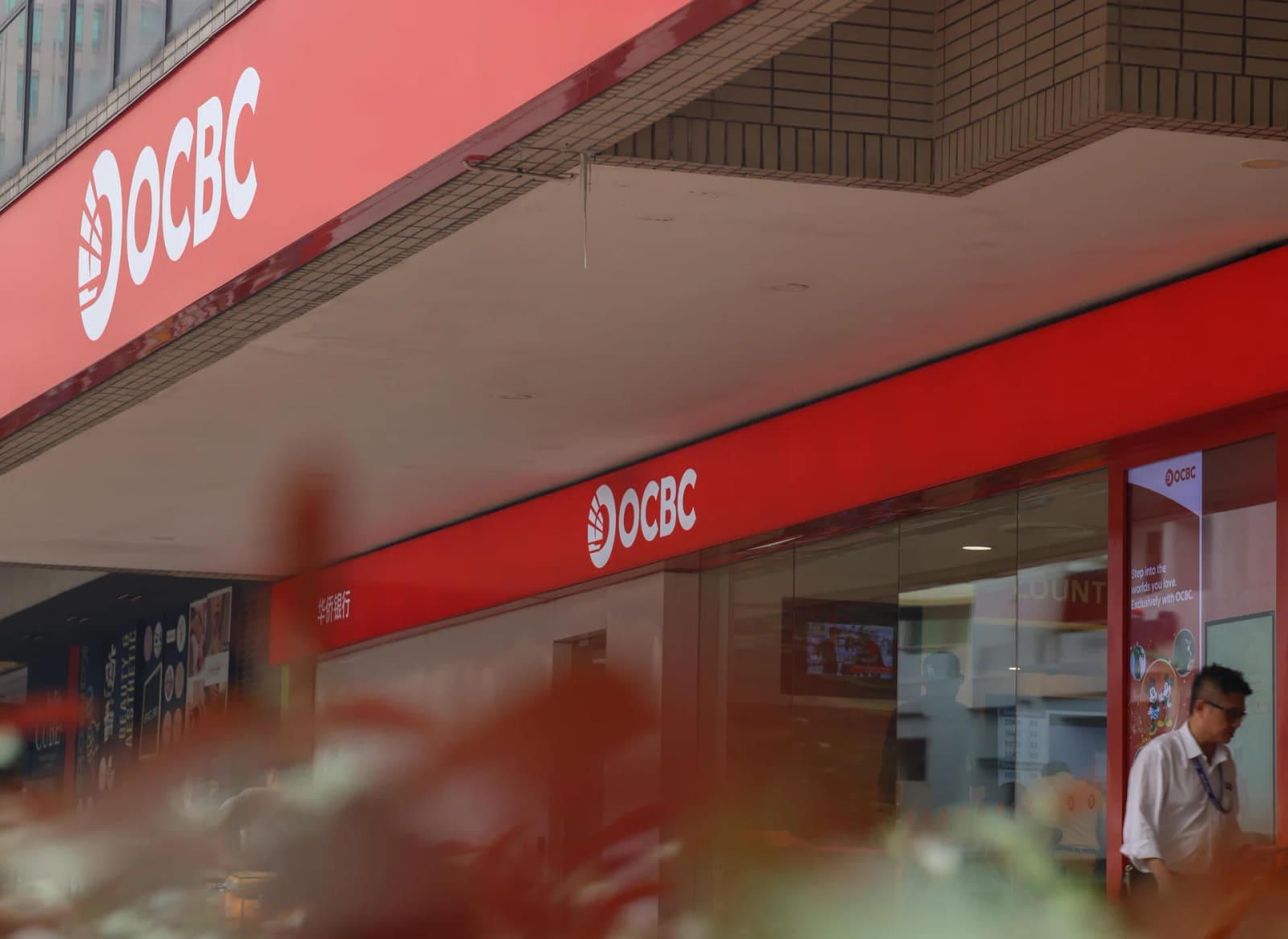
OCBC Downgrade Follows 19% Rally Despite Raised Price Target
CGS International cites limited upside and lower dividend yield versus Singapore peers as stock trades near analyst target
KEY TAKEAWAYS
- ·CGS International downgraded OCBC to hold after the stock rallied 19.1 percent since June, with the new S$28.40 target implying 1 percent downside from current levels.
- ·The bank's estimated fiscal 2027 dividend yield of 3.2 percent trails DBS at 4.8 percent and UOB at 4.5 percent after capital return exercise ends.
- ·Meaningful ROE expansion is expected only in fiscal 2028 following completion of HSBC Indonesia wealth business integration targeted for mid-2027.
Valuation Catches Up to Fundamentals
CGS International downgraded OCBC to hold from buy on July 21, marking a shift in sentiment after the Singapore lender's shares climbed 19.1 percent since June. The brokerage raised its price target to S$28.40 from S$26, but with the stock trading at S$28.69, that leaves just 1 percent downside from current levels.
Analysts Tay Wee Kuang and Tan Jie Hui adjusted their market risk premium assumption to 5.5 percent from 6 percent, reflecting what they described as stabilizing macroeconomic conditions. That recalibration lowered OCBC's implied cost of equity to 7.8 percent from 8.4 percent, supporting the higher valuation.
The downgrade hinges on a straightforward calculation: the stock has already priced in much of the near-term upside. CGS International expects meaningful return-on-equity expansion to materialize only in fiscal 2028, after OCBC completes the integration of HSBC Indonesia's wealth management business. Management aims to wrap that deal by mid-2027.
Dividend Yield Trails Local Rivals
OCBC's dividend profile presents another headwind. The bank is set to finish its capital return exercise by the end of fiscal 2026, after which it will revert to a standard 50 percent core payout ratio. CGS International estimates that translates to a fiscal 2027 dividend yield of roughly 3.2 percent.
That figure lags DBS, which carries an estimated yield of 4.8 percent, and UOB at around 4.5 percent. For income-focused investors in Singapore's banking sector, the gap is material.
The brokerage projects OCBC will report second-quarter fiscal 2026 net profit of S$1.93 billion, up 6.4 percent year-on-year but down 2.1 percent quarter-on-quarter. Revenue is forecast at S$3.83 billion, an 8.1 percent annual increase and a marginal 0.1 percent sequential gain.
Wealth Management Drives Earnings Lift
CGS International raised its earnings-per-share estimates by 2.1 percent across fiscal 2026 through 2028, citing potential synergies between OCBC's wealth management and insurance operations. Wealth management fees are expected to surge 43.4 percent year-on-year to S$400 million in the second quarter, while asset quality is projected to hold steady with credit costs at 23 basis points.
The analysts outlined a range of scenarios that could alter the bank's trajectory. Upside risks include US Federal Reserve rate hikes that would lift the Singapore Overnight Rate Average and widen net interest margins. Stronger loan growth from reallocating capital away from lower-yielding liquid assets could also boost returns, as could accelerated net new money flows into the high-ROE wealth business.
Downside risks center on integration costs for the HSBC Indonesia wealth unit exceeding expectations, a macroeconomic downturn that drives elevated provisioning, or slower wealth inflows relative to peers.
Broader Context for Singapore Banks
The CGS International move follows Citi's decision last week to place UOB on a 30-day downside catalyst watch. Shares of Singapore's three local banks hit record levels earlier in July, lifting the Straits Times Index to new highs. Citi warned on July 18 that the market had grown overly optimistic in pricing an asset quality turnaround for UOB.
Singapore's banking sector has benefited from a combination of rising interest rates, resilient credit quality, and strong wealth management growth across the region. But as valuations approach or exceed analyst targets, the question for investors shifts from whether fundamentals are solid to whether the market has already discounted the good news.
OCBC's integration of the HSBC Indonesia wealth business remains a key variable. The deal adds scale in a fast-growing market, but execution risk persists until the acquisition is fully absorbed. The timeline stretches into mid-2027, leaving a gap before the ROE benefits show up in reported earnings.
For now, CGS International sees the stock fairly valued, with the next catalyst tied to evidence of operating leverage in the wealth and insurance franchises rather than multiple expansion.
RELATED STORIES
DBS Posts Record Quarterly Profit of S$3.08 Billion, Lifts Full-Year Outlook
Priyanka V. Rao · 2 min
Singapore Court Awards UOB S$76 Million in Marina Collection Fraud Case
Priyanka V. Rao · 3 min
Singapore Brokerages Raise STI Targets on Earnings Strength
Jun-ho Seo · 3 min

Addvalue Technologies Lands $5 Million in Space and Radio Contracts
Tran Quoc Bao · 3 min
Spot something wrong? Email editor@briefasia.com. We log every correction publicly.