Technology · Products
Mitsubishi Philippines Readies Plug-In Hybrid as Pure EV Plans Remain Distant
The Japanese automaker will unveil a flagship PHEV model within weeks while doubling down on hybrids over battery-electric vehicles, citing infrastructure gaps and slower-than-expected global adoption.
KEY TAKEAWAYS
- ·Mitsubishi Motors Philippines will launch a plug-in hybrid flagship in late August, featuring emergency power capability for 10 days and water-fording depth of 30 to 40 centimeters.
- ·The automaker is prioritizing hybrids over pure EVs due to slower-than-expected global adoption and insufficient charging infrastructure in the Philippines.
- ·Mitsubishi has committed PHP 7 billion to locally manufacture a hybrid model by mid-2028 under the government's Electric Vehicle Incentive Strategy.
A Flagship Hybrid Arrives
Mitsubishi Motors Philippines will introduce a plug-in hybrid electric vehicle in late August, the company's chairman Noriaki Hirakata disclosed during a media briefing on August 10. While Hirakata stopped short of naming the model, he described it as a global flagship capable of serving as an emergency power source for approximately 10 days during blackouts and handling water depths of 30 to 40 centimeters, features tailored for Southeast Asian conditions.
The vehicle carries a premium price point, and Mitsubishi plans to offer financing packages to make it accessible to Filipino buyers. Industry observers note the specifications align closely with the Outlander PHEV, though the company has not confirmed the model's identity.
The launch underscores Mitsubishi's deliberate strategy of prioritizing hybrid powertrains over battery-electric vehicles in the Philippine market, a decision rooted in both infrastructure realities and shifting global demand patterns.
The EV Slowdown Nobody Predicted
Hirakata pointed to what he termed "low acceptance" of pure EVs as a primary factor shaping the company's product roadmap. Five to 10 years ago, Mitsubishi and rival automakers anticipated rapid consumer migration to battery-electric vehicles and allocated capital accordingly. Those projections have not materialized.
"They made huge investments the past five years, only to be disappointed by very low acceptance of pure EV everywhere in the world," Hirakata said. The gap between forecast and reality has prompted manufacturers to redirect focus toward hybrid and plug-in hybrid technologies, which offer electrified driving without full dependence on charging networks.
The Philippines presents additional complications. Hirakata cited Japan's experience as instructive: deploying chargers is straightforward, but ongoing maintenance costs are substantial, and identifying parties willing to bear those expenses remains unresolved. The result is a charging ecosystem that evolves far more slowly than vehicle development cycles.
Competing Against EV-First Entrants
Mitsubishi's hybrid-first approach places it at odds with competitors such as BYD and Tesla, which have built their regional presence around battery-electric models. Hirakata acknowledged that some customers seeking EVs have already turned to BYD, but he expressed confidence that Mitsubishi's six-decade presence in the Philippines provides brand equity that newer entrants cannot replicate quickly.
"I don't believe BYD established the brand over only one or two years," Hirakata said. The company is targeting a 20% market share in the Philippines as soon as this year, a figure that would represent a significant gain in a competitive landscape reshaped by Chinese manufacturers.
A Seven-Billion-Peso Manufacturing Bet
The Philippines occupies an outsized role in Mitsubishi's global operations. Hirakata described the country as the automaker's largest market outside Japan, contributing materially to worldwide revenue. That strategic importance is reflected in the company's capital allocation: Mitsubishi has committed PHP 7 billion toward local manufacturing under the government's Electric Vehicle Incentive Strategy.
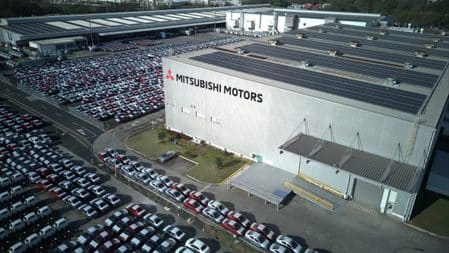
The plan calls for production of a hybrid model by mid-2028. Mitsubishi intends to assemble battery packs at its Sta. Rosa facility, increase procurement from Philippine suppliers over time, and potentially expand the plant's current 50,000-unit annual capacity. The investment signals a long-term commitment that extends beyond import operations into manufacturing infrastructure.
What Comes Next
Mitsubishi's hybrid focus reflects a broader recalibration across the auto industry as manufacturers reconcile ambitious electrification timelines with slower real-world adoption. In markets where charging infrastructure lags and upfront EV costs remain prohibitive, hybrids offer a transitional technology that reduces emissions without requiring wholesale changes to refueling behavior.
For the Philippines, the question is whether this transitional phase stretches into a decade or longer. Mitsubishi's manufacturing timeline suggests the company is preparing for a hybrid-dominant market through at least 2030. Pure EVs may arrive eventually, but the conditions that would make them viable at scale - reliable charging networks, competitive pricing, and consumer confidence in range - remain years away.
In the meantime, Mitsubishi is betting that Filipino buyers will value the familiarity of a brand with deep local roots over the novelty of pure electric powertrains. Whether that wager pays off will depend on how quickly competitors can build trust and how long infrastructure gaps persist.
RELATED STORIES
Mitsubishi Commits $120 Million to Philippine Hybrid Push as Scale Challenges Persist
Priyanka V. Rao · 3 min

Singapore Cloud Provider Enters Philippines Under New Telecom Law
Mariel D. Santos · 2 min
Philippines Regulator Seeks to Drop VAT on Power System Losses
Mariel D. Santos · 2 min

Manila Projects Debt Stock to Hit P21.5 Trillion as Peso Weakness Compounds Borrowing Costs
Priyanka V. Rao · 3 min
Spot something wrong? Email editor@briefasia.com. We log every correction publicly.