Finance · Markets
Malaysian Ringgit Climbs on Export Strength as Markets Eye Fed Signals
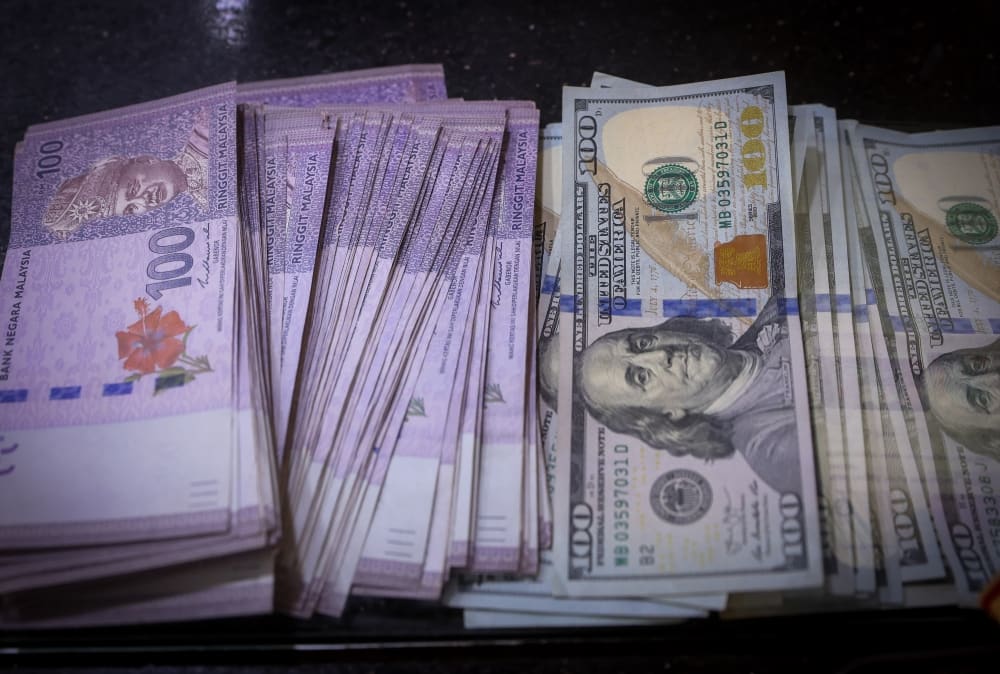
The currency edged past 4.03 per dollar Monday morning, with economists watching whether strong July trade data can sustain momentum into year-end.
KEY TAKEAWAYS
- ·Malaysia's ringgit opened at 4.0360 per US dollar Monday, up from 4.0365 on Friday, supported by strong July export data that hint at faster economic growth in the second half of 2026.
- ·Bank Muamalat Malaysia expects the currency to trade between 4.03 and 4.05 today, with the 4.03 level now in sight after a 0.16 per cent weekly gain.
- ·Markets are watching the Federal Reserve's Jackson Hole symposium from August 27 to 29 for clues on the September rate decision, while US government debt exceeding 40 trillion dollars keeps long-term Treasury yields elevated.
Currency Opens Firmer on Trade Optimism
Malaysia's ringgit opened stronger against the US dollar Monday morning, trading at 4.0360 per greenback at 8:05 a.m., up slightly from Friday's close of 4.0365. The move extends a modest rally that saw the currency gain 0.16 per cent last week, closing at 4.0385, according to Bank Muamalat Malaysia Bhd.
Mohd Afzanizam Abdul Rashid, chief economist at Bank Muamalat Malaysia, attributed the firmer tone to recent macroeconomic releases, particularly July export data that exceeded market expectations. Those figures suggest Malaysia's economic expansion may accelerate in the latter half of 2026, he noted.
The ringgit has now tested the psychologically important 4.03 level, a threshold it last breached in early August. Mohd Afzanizam told Bernama he expects the currency to trade in a 4.03 to 4.05 band through the day as traders weigh domestic fundamentals against global risk appetite.
Regional Cross-Rates Show Mixed Picture
Against other major currencies, the ringgit posted gains across the board in early trading. It strengthened to 2.5403 per 100 Japanese yen from 2.5449 on Friday, and firmed to 5.5108 against the British pound from 5.5118. The euro also weakened, with the ringgit rising to 4.7161 from 4.7227.
Performance against regional peers was more varied. The ringgit edged up marginally versus the Singapore dollar, moving to 3.1805 from 3.1809, and ticked higher against the Indonesian rupiah to 228.0 from 228.1. It held flat against the Philippine peso at 6.54 and slipped slightly versus the Thai baht, trading at 12.3675 compared with 12.3474 at the prior close.
The mixed regional showing reflects diverging monetary policy expectations across Southeast Asia, with some central banks signaling caution on rate cuts while others maintain tighter stances to defend their currencies.
US Treasury Yields in Focus
Market participants are closely monitoring long-term US Treasury yields, which have climbed in recent weeks despite expectations that the Federal Reserve will begin cutting rates. Mohd Afzanizam pointed to the size of US government debt, which recently surpassed 40 trillion dollars, as a structural headwind for any policy-driven attempts to suppress market interest rates.
"Clearly, such intervention would only have a transitory effect, as what really matters is the size of the fiscal deficit," he said. The 10-year Treasury yield has hovered near multi-month highs, reflecting investor concerns that persistent federal borrowing will keep upward pressure on longer-dated rates even as the Fed eases short-term policy settings.
That dynamic complicates the outlook for emerging-market currencies, including the ringgit. A steeper US yield curve typically attracts capital flows back to dollar-denominated assets, offsetting the boost that EM currencies receive from improved domestic growth prospects.
Jackson Hole Symposium Looms
All eyes now turn to the Federal Reserve's annual Jackson Hole Economic Symposium, scheduled for August 27 to 29 in Wyoming. Chair Jerome Powell is expected to deliver remarks that could clarify the central bank's rate trajectory heading into its September policy meeting.
Markets are pricing in a high probability of a 25-basis-point cut in September, but uncertainty remains over the pace of subsequent moves. Any hawkish tilt in Powell's language, particularly around inflation risks or labor-market resilience, could trigger a pullback in risk assets and pressure Asian currencies.
For Malaysia, the interplay between domestic growth momentum and external financing conditions will determine whether the ringgit can sustain its recent gains. July's export figures, which showed double-digit growth in electronics shipments to China and the US, offer a buffer, but portfolio flows remain sensitive to shifts in Fed policy expectations.
Outlook Hinges on Data and Fed Tone
Economists say the ringgit's near-term trajectory depends on two factors: whether Malaysia's trade surplus continues to widen, and how aggressively the Fed signals it will ease. A widening surplus would reinforce the case for a stronger currency by boosting foreign-exchange inflows from merchandise exports, particularly in semiconductors and palm oil.
At the same time, a dovish Fed pivot could weaken the dollar broadly, lifting Asian currencies in tandem. However, if US yields remain elevated on fiscal concerns, that tailwind may prove limited.
Bank Muamalat's Mohd Afzanizam maintains a cautiously optimistic view, noting that strong macroeconomic fundamentals should keep the ringgit well supported in the near term, barring any sharp deterioration in global risk sentiment or unexpected domestic policy shifts.
RELATED STORIES
Ringgit Rally Faces Correction Risk as Fed Chair Takes Stage
Cheng Wei-Lun · 3 min
Malaysian Ringgit Faces Profit-Taking Risk After Six-Day Rally
Cheng Wei-Lun · 2 min

Malaysian Stocks Hover Near Flat as Fed Symposium Looms
Cheng Wei-Lun · 3 min

Malaysia's NCT and RHB Partner to Expand SME Access to Capital
Priyanka V. Rao · 3 min
Spot something wrong? Email editor@briefasia.com. We log every correction publicly.