Finance · Deals
KKR Sets Premium Trigger on First Gen Control at P40 Billion
US investment firm's proposal introduces structural tripwire on Lopez holding company transactions, separate from existing key-man clauses
KEY TAKEAWAYS
- ·KKR proposed buying 8.43% of First Gen from First Philippine Holdings with a control premium clause pricing ownership change at roughly P40 billion above base valuation of P126 billion.
- ·The clause triggers on any transaction changing control at First Gen or parent entities Lopez Holdings, Lopez Inc., distinct from existing P23.5 billion key-man provisions tied to Piki Lopez's role.
- ·KKR holds 19.9% economic interest in First Gen worth approximately P20 billion but only 14.1% voting rights, a gap the proposed shareholders' agreement would address.
The Structure Behind the Number
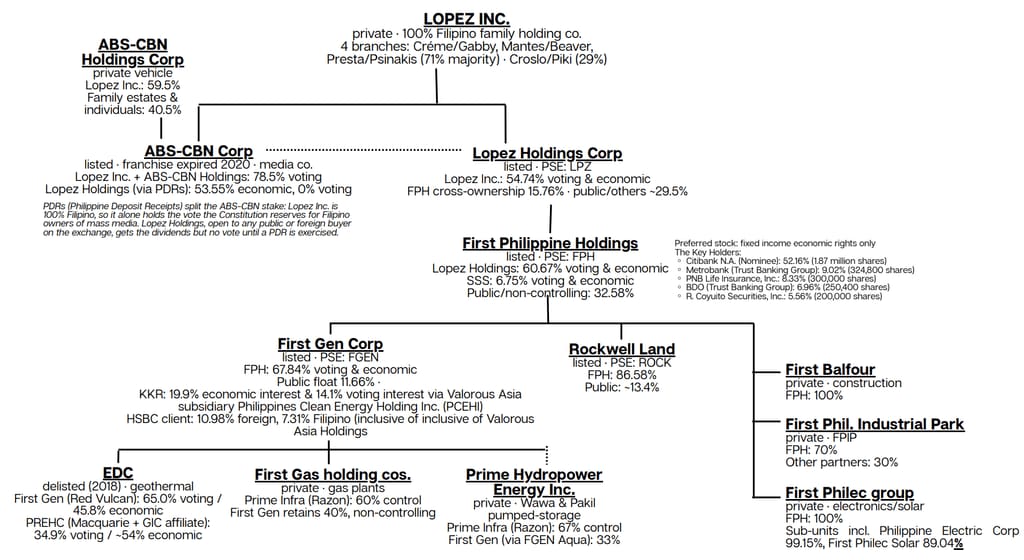
Kohlberg Kravis Roberts sent First Philippine Holdings Corp. a three-part proposal on July 10. The firm wants to purchase 8.43% of First Gen Corp. directly from FPH, enter a shareholders' agreement, then launch a tender offer for the remaining public float of 11.67% ahead of a potential delisting. First Philippine Holdings disclosed the terms to the Philippine Stock Exchange on August 13.
Buried in that disclosure sits a provision with wider reach. Any transaction producing a direct or indirect change of control, whether at First Gen or at the holding companies above it, triggers a mandatory tender offer at a minimum 30% premium to KKR's base offer price. That puts the control price at roughly P46 per share, according to First Philippine Holdings. KKR's base offer works out to approximately P35 per share, about 25% above First Gen's P28 close on August 13.
Applied across First Gen's 3.6 billion outstanding shares, the gap between the two valuations runs to roughly P40 billion. That figure represents what KKR believes a control transaction should cost beyond a minority stake purchase. The clause applies not only to deals at First Gen itself but also to transactions at First Philippine Holdings, Lopez Holdings, or Lopez Inc., the parent entities in the ownership chain.
Preliminary Terms, Specific Language
First Philippine Holdings described the proposal as preliminary, non-binding, and not capable of acceptance. KKR reserves the right to amend, suspend, or withdraw at any time. Yet the disclosure includes exact share counts, precise premium formulas, and detailed transaction steps. That level of specificity is unusual for early-stage discussions.
The timing matters. The proposal surfaced during a week dominated by other Lopez Group developments. ABS-CBN announced a P6 billion capital raise on August 10. The same day, businessman Ramon Ang purchased a 25.68% stake in Lopez Inc. from Crème Investment Corp., a holding vehicle for one branch of the Lopez family. Eugenio Lopez III, whose branch sold the stake, framed the sale as a step toward resolving family tensions. Federico Lopez, known as Piki, who serves as Lopez Inc. president, welcomed Ang as a long-time friend and partner.
None of the three men used the word control in their public statements. All three emphasized continuity and partnership. KKR's clause does not contradict those characterizations, but it does attach a measurable cost to any transaction that shifts ownership at the top of the Lopez structure, regardless of how that transaction is described.
Three Tripwires, Two Logics
First Gen already operates under two sets of protective clauses. Its agreements with Prime Infra and its credit facility with BDO Unibank include key-man provisions tied specifically to Piki Lopez. If he is removed as First Gen chairman and CEO, those clauses activate, exposing the company to roughly P23.5 billion in obligations across hydro and gas transactions, plus potential acceleration of the BDO facility.
KKR's clause operates differently. It is not tied to any individual executive. It is triggered by a change in shareholding at First Gen or any of the companies above it in the ownership chain. The distinction is structural rather than personal.
That creates two separate logics running in parallel. The Prime Infra and BDO clauses protect a specific role. KKR's clause prices a change in ownership. A resolution that satisfies one does not automatically satisfy the other.
The Cemco Question
Whether the Ang transaction on August 10 triggered KKR's clause is unclear. The answer turns on a legal principle established in a 2007 Supreme Court case involving Cemco Holdings. That case held that acquiring a parent company can, in certain circumstances, count as an indirect acquisition of its listed subsidiaries, potentially triggering tender offer obligations.
Lopez Inc. sits atop a chain of listed companies including Lopez Holdings, ABS-CBN, First Philippine Holdings, First Gen, and Rockwell Land. No Philippine court has tested the Cemco doctrine on a structure of this complexity.
The ownership math is straightforward. Lopez Inc. is held by four family branches: Presta at 15.98%, Croslo at 29.17%, Mantes at 29.17%, and Crème at 25.68%. Ang's purchase of the Crème stake does not by itself give him majority control of Lopez Inc. That aligns with how all three parties described the transaction.
KKR's History with First Gen
KKR first acquired shares in First Gen through a tender offer in 2020, purchasing roughly 11.9% of the company. A second tender offer in October 2021 added another 7.3%, worth approximately P8.68 billion at the time. The combined position brought KKR's stake to 19.9%, where it has remained since.
That stake represents economic interest, KKR's share of First Gen's profits and asset value. At First Gen's August 13 close of P28, the position is worth approximately P20 billion. But KKR's voting interest, the share of actual votes it can cast in company decisions, stands at only 14.1%. The six-point gap means KKR carries nearly a fifth of First Gen's economic exposure without proportional influence over governance.
The structure KKR proposed in July, buying additional shares directly from First Philippine Holdings and entering a shareholders' agreement, would narrow that gap. It also clarifies why the firm is seeking decision-making weight that matches the capital it already has deployed.
What the Clause Actually Protects
The control premium clause does not prevent transactions. It prices them. If ownership at any level of the Lopez holding structure changes hands in a way that shifts control, the clause establishes a floor for what that transaction must pay First Gen shareholders.
Whether a court ruling on Piki Lopez's role, with no accompanying share sale, would count as the kind of indirect change of control the clause describes remains an open question. A resolution that involves additional share sales, a buyout, or one party building a controlling position would more clearly fall within the clause's scope, because ownership would have actually moved.
KKR holds its First Gen position through Valorous Asia's subsidiary, Philippines Clean Energy Holding Inc. At a First Philippine Holdings employee townhall on April 17, Piki Lopez named KKR among the institutional investors he viewed as endorsing his leadership. The firm has now been a First Gen shareholder for six years and has completed two prior tender offers with the company.
The proposal remains non-binding. But the premium formula and the transaction scope are now on file with the Philippine Stock Exchange. That turns a theoretical cost into a documented one, attached to any deal that crosses the threshold the clause defines.
RELATED STORIES

Philippines Senator Calls for Simpler Access to Financial Services Beyond Fee Cuts
Mariel D. Santos · 3 min
Philippines' SSS Looks Abroad as Investment Portfolio Reaches P1.27 Trillion
Priyanka V. Rao · 3 min

Ayala Corp Earnings Fall 7% as Real Estate Slowdown Offsets Gains Elsewhere
Priyanka V. Rao · 3 min

KKR Eyes 8.4% Stake in Philippines Power Producer First Gen
Mariel D. Santos · 3 min
Spot something wrong? Email editor@briefasia.com. We log every correction publicly.