Technology · AI
Kioxia Begins Sampling Next-Generation Flash Memory for AI Infrastructure
Japanese chipmaker unveils 3D memory technology targeting data center customers as demand for AI storage accelerates across Asia
KEY TAKEAWAYS
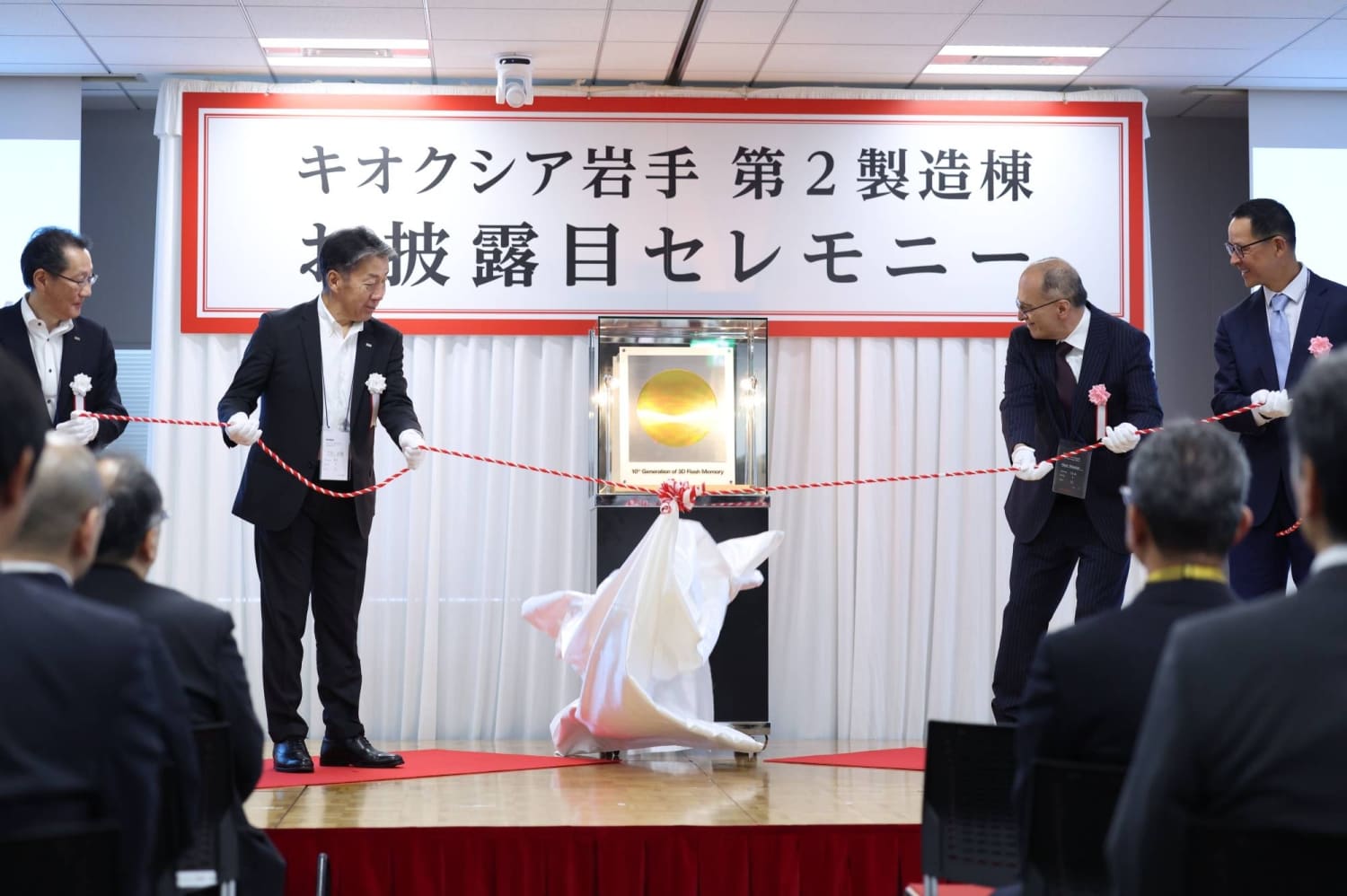
- ·Kioxia Holdings started distributing sample units of its new 3D flash memory chip designed for AI data centers, unveiled at its Kitakami plant in Iwate Prefecture by CEO Hiroo Ota.
- ·The Japanese chipmaker faces competition from SK hynix and Samsung in the AI storage market, with typical sampling-to-production timelines running six to nine months before volume shipments begin.
- ·Japan has allocated over ¥2 trillion in semiconductor subsidies across manufacturers, with Kioxia receiving approximately ¥93 billion for capacity expansion and next-generation technology development.
New Memory Architecture Targets AI Workloads
Kioxia Holdings has begun distributing sample units of its latest 3D flash memory chip, a product engineered specifically for artificial intelligence data center applications. The company unveiled the technology at its Kitakami manufacturing facility in Iwate Prefecture, with CEO Hiroo Ota presenting the chip to industry partners and media.
The timing reflects intensifying competition among Asian semiconductor manufacturers to capture a share of the AI infrastructure market. Data centers running large language models and training workloads require storage systems that can handle massive sequential reads and writes, a different performance profile from consumer SSDs or traditional enterprise drives.
Kioxia's entry follows similar moves by SK hynix and Samsung, both of which have released specialized memory products for AI servers over the past eighteen months. The Japanese firm, formerly Toshiba Memory, has historically focused on consumer and enterprise NAND flash but now faces pressure to diversify into higher-margin segments as commodity prices remain volatile.
Asia's Memory Supply Chain Reconfigures
The Kitakami plant, located in northeastern Japan, represents one of the few advanced memory fabrication facilities outside South Korea and Taiwan. Kioxia operates the site in partnership with Western Digital, though the two companies have pursued increasingly independent product roadmaps since their joint venture began scaling back shared development in late 2024.
Industry analysts note that Japan's semiconductor revival strategy, backed by government subsidies exceeding ¥2 trillion across multiple chipmakers, has created incentives for domestic firms to target emerging applications rather than compete directly in mature markets. Kioxia received approximately ¥93 billion in state support for capacity expansion and next-generation technology development.
The new 3D architecture stacks memory cells vertically, a now-standard technique that increases density without requiring smaller transistor geometries. What differentiates products for AI use cases is firmware optimization and interface speeds. Modern training clusters demand sustained throughput above 10 GB/s per drive, with latency tolerances measured in microseconds.
Sampling Phase Signals Production Timeline
Kioxia has not disclosed when mass production will begin or which hyperscale customers are evaluating the samples. Typically, memory manufacturers distribute engineering samples six to nine months before volume shipments commence, allowing data center operators to validate performance in live environments and adjust server designs accordingly.
The company faces a delicate balancing act. Demand for AI-optimized storage is growing rapidly, but the total addressable market remains smaller than traditional enterprise segments. Overcommitting fabrication capacity to a niche product risks margin pressure if adoption lags, while underinvesting could cede market share to faster-moving rivals.
China's data center buildout, despite U.S. export restrictions on advanced GPUs, continues to drive memory demand across the region. Domestic Chinese firms have ramped purchases of non-restricted components, including high-performance SSDs, to support inference workloads and smaller-scale training projects that fall outside current regulatory scope.
Competitive Landscape Tightens
South Korean manufacturers currently dominate the AI memory market. SK hynix supplies high-bandwidth memory for Nvidia's flagship GPUs, while Samsung has secured design wins with multiple cloud providers for its PM9E3 enterprise SSD series, which targets AI read-intensive applications.
Kioxia's challenge is to differentiate on either performance or cost. The company has historically competed on price in consumer markets, but AI customers prioritize reliability and endurance. A single drive failure in a distributed training cluster can halt an entire job, making total cost of ownership more important than upfront unit price.
Japan's broader semiconductor strategy hinges on reclaiming technological leadership in areas where domestic firms once led. Memory was a cornerstone of the country's electronics industry in the 1980s, but two decades of market share losses to South Korean competitors left only Kioxia as a significant player. Reviving that position will require sustained investment and execution as customer requirements evolve.
The Kitakami unveiling positions Kioxia as a credible alternative supplier at a moment when data center operators are actively seeking to diversify their vendor base. Whether that translates into volume orders depends on how the samples perform under real-world AI workloads and how aggressively the company prices its products once production scales.
RELATED STORIES
Honda and Nissan Align on Software-Defined Vehicle Development
Cheng Wei-Lun · 2 min
Japan's Military Adopts NTT Optical Network for AI-Ready Defense Communications
Aiko Nakamura · 3 min
Kioxia Pushes Flash Memory to Replace DRAM Amid Market Squeeze
Jun-ho Seo · 3 min

Fujitsu to Exit Commodity Hardware as AI Shifts Production Strategy
Aiko Nakamura · 4 min
Spot something wrong? Email editor@briefasia.com. We log every correction publicly.