Asia · Trade
India Walks Away From US Trade Deal After Accepting Asymmetric Terms
New Delhi halted negotiations two weeks after both sides claimed the bilateral agreement was 99 percent complete, citing lack of competitive advantage over regional peers.
KEY TAKEAWAYS
- ·India halted a bilateral trade agreement with the US two weeks after both sides said it was 99 percent complete, demanding better terms than those offered to Vietnam and other regional competitors.
- ·The February framework required India to eliminate tariffs on US goods and halt Russian oil imports, while allowing the US to apply an 18 percent reciprocal tariff rate on Indian exports, up from 2.6 percent.
- ·Two new Section 301 investigations by the US Trade Representative target India for forced labor compliance and excess capacity across seven sectors, threatening additional duties that could offset any trade deal benefits.
The Sudden Reversal
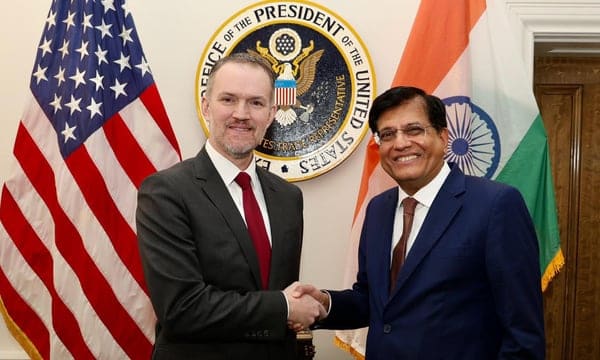
Two weeks ago, negotiators from Washington and New Delhi announced that a bilateral trade agreement between India and the United States was 99 percent complete. US Trade Representative Jamieson Greer had just concluded talks in the Indian capital, and officials on both sides projected confidence. Days later, India pulled back entirely.
Commerce Minister Piyush Goyal explained the reversal in plain terms. India would not sign unless the United States provided "some competitive advantage over what is being given to countries like Vietnam, Thailand, the Philippines, Indonesia, Malaysia, China, Bangladesh, Sri Lanka, and other neighboring countries." The statement marked a sharp departure from the momentum that had built since early 2025, when leaders in both capitals launched "Mission 500" to double bilateral trade to $500 billion by 2030.
What India Agreed to in February
The framework announced in early February revealed terms that heavily favored Washington. India committed to eliminating or reducing tariffs on all US industrial goods and a wide range of agricultural products. In exchange, the United States reserved the right to apply a reciprocal tariff rate of 18 percent on Indian exports.
At the time, the tariff rate applied to Indian goods stood at roughly 2.6 percent. The February framework would have allowed the US to increase duties nearly sevenfold while India opened sectors it has historically protected, including agriculture. New Delhi also agreed to halt direct or indirect imports of Russian oil, a significant geopolitical concession given Moscow's role as a strategic partner for decades. In return, the US agreed to remove a 25 percent duty imposed in August 2025 over those same oil purchases.
Indian officials celebrated the framework as a "landmark trade victory" that unlocked the "$30-trillion US market." The asymmetry in the terms, however, suggested a different calculus.
The Supreme Court Intervention
The framework collapsed when the US Supreme Court ruled that President Donald Trump lacked authority to impose reciprocal tariffs under the International Emergency Economic Powers Act. That legislation had been the legal basis for high tariffs imposed on 57 countries in April 2025. The ruling forced both governments back to negotiations.
India's willingness to accept the February terms remains difficult to explain. Its subsequent refusal to finalize the deal, however, reflects new provocations from Washington.
Section 301 Investigations
Within weeks of the Supreme Court decision, the Trump administration launched two separate investigations under Section 301 of the US Trade Act of 1974. That provision grants the Trade Representative unilateral authority to investigate and impose tariffs on trading partners.
The first investigation targets 54 countries, including India, for allegedly failing to prohibit imports of goods produced with forced labor. The penalty under consideration is an additional 10 percent duty on imports.
The second investigation examines structural excess capacity across 22 sectors in 16 countries. India is among them, with seven sectors under scrutiny, including construction goods. The Trade Representative has not yet specified the duty rates it intends to impose, but the breadth of sectors targeted means any resulting tariffs could significantly reduce Indian exports to the United States, its largest trading partner.
The Predictability Problem
Bilateral trade agreements are typically designed to create a stable, transparent environment for businesses operating across borders. The Trump administration's approach has been the opposite. Even after extracting concessions in February, the US government opened new fronts through unilateral investigations that could negate any market access gains India might have secured.
For New Delhi, the risk is clear. Signing the agreement under current conditions could leave Indian exporters exposed to tariffs imposed through mechanisms outside the bilateral framework. The Commerce Minister's statement about competitive advantage reflects that calculation. Without terms that match or exceed those offered to Vietnam, Thailand, and other regional competitors, India sees little reason to proceed.
What Comes Next
The bilateral trade agreement remains on hold. Negotiations that began with optimism in early 2025 and accelerated under the "Mission 500" banner have stalled. The original deadline of fall 2025 came and went. The February framework collapsed under legal and political pressure. And the latest round of Section 301 investigations has deepened New Delhi's skepticism.
Both governments continue to describe the other as an important trading partner. Total bilateral trade between India and the United States reached approximately $190 billion in 2024, making the US India's second-largest trading partner. But the gap between political rhetoric and negotiating reality has widened.
India's decision to walk away signals a harder line than it adopted in February. Whether Washington is willing to offer the competitive terms New Delhi now demands will determine if the deal can be revived. For now, the agreement that was once 99 percent complete is indefinitely paused.
RELATED STORIES
Eurasian Security Bloc Convenes as Shein Prices Hong Kong IPO
Cheng Wei-Lun · 3 min
India's 7.8% GDP Growth Sparks Debate Over Revised Base Year Calculations
Rajesh K. Iyer · 3 min
Godrej Industries Commits $2.1 Billion to Haryana Expansion
Rajesh K. Iyer · 3 min

Kubota Expands Indian Production to Target Western Markets
Priyanka V. Rao · 3 min
Spot something wrong? Email editor@briefasia.com. We log every correction publicly.