Technology · Products
Honor Unveils Gimbal-Equipped Smartphone With System-Level AI Agent
The Robot Phone features four-axis stabilization hardware and a 7,060mAh battery, targeting China's premium segment at 9,999 yuan starting price
KEY TAKEAWAYS
- ·Honor launched the Robot Phone in China with a four-axis titanium gimbal and system-level AI agent, priced at 9,999 yuan for the base 12GB/512GB model and 12,999 yuan for the 16GB/1TB version.
- ·The YOYO Pro AI agent can execute multi-step instructions across applications and control hardware functions including the integrated gimbal and camera system.
- ·The device enters China's competitive premium segment where the 5,000 to 10,000 yuan price band has grown faster than other tiers in the first half of 2026.
Hardware Meets Intelligence
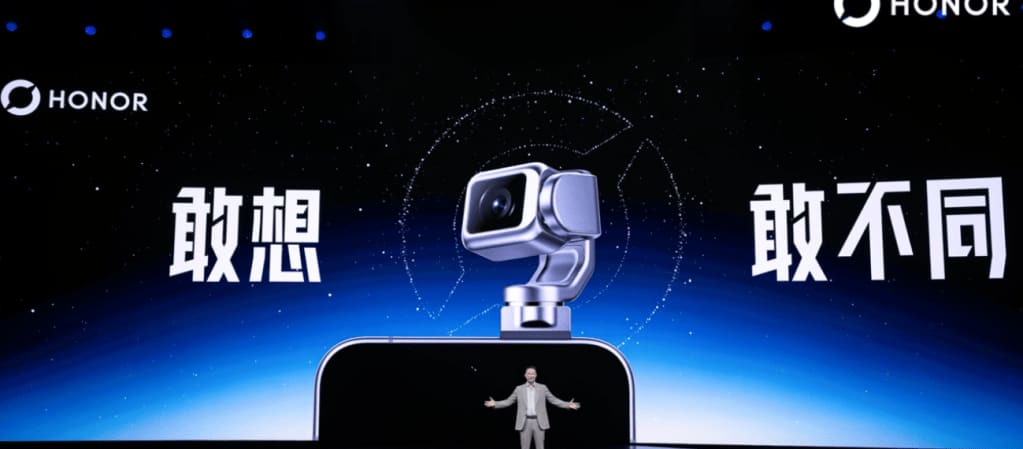
Honor introduced its Robot Phone this week, a device that combines physical stabilization hardware with artificial intelligence software in a single package. The smartphone integrates a four-axis titanium gimbal directly into its body, paired with what the company describes as a system-level AI agent architecture.
The device measures 9.59 millimeters in thickness and weighs 248 grams, according to Honor. It houses a 7,060mAh battery and a 6.31-inch display. The company is offering two configurations: a 12GB RAM model with 512GB storage priced at 9,999 yuan (approximately $1,370 USD), and a 16GB RAM version with 1TB storage at 12,999 yuan (roughly $1,780 USD).
Pre-orders opened on August 12, with general availability set for August 18 in China.
Gimbal Integration and AI Coordination
The titanium gimbal system provides four degrees of freedom for camera stabilization, a feature typically reserved for external accessories or professional equipment. By embedding this mechanism into the phone chassis, Honor is betting that users will prioritize video capture quality and hands-free shooting capabilities.
The AI component, branded YOYO Pro, operates at the system level rather than as a standalone app. Honor claims the agent can process extended instruction sequences that span multiple applications, and can trigger functions linked to the gimbal, camera module, and other hardware subsystems. This suggests the AI layer has deeper hooks into the operating system than typical virtual assistants.
Asia's Premium Push
Honor's pricing positions the Robot Phone squarely in the premium segment, competing with flagship devices from Xiaomi, Oppo, and Vivo in the Chinese market. The company, which became independent from Huawei in 2020, has been rebuilding its brand around differentiated hardware and software features.
The gimbal-phone category remains niche. Vivo experimented with gimbal cameras in its X50 series in 2020, but the feature did not become widespread. Honor's approach differs by pairing the stabilization hardware with an AI agent designed to automate multi-step tasks, potentially expanding use cases beyond video recording.
China's smartphone market has seen renewed competition in the premium tier, with domestic brands filling space left by constrained Apple growth and Huawei's gradual return. According to industry data, the 5,000-10,000 yuan price band grew faster than other segments in the first half of 2026, driven by consumers upgrading to devices with advanced photography, battery life, and AI features.
Software Architecture Questions
Honor has not disclosed technical details about YOYO Pro's architecture, including whether it uses on-device models, cloud inference, or a hybrid approach. The ability to execute "longer instructions across applications" implies some form of workflow automation or task chaining, capabilities that require either robust natural language understanding or pre-defined action templates.
System-level integration raises questions about privacy and permissions. If the AI agent can control hardware and traverse app boundaries, the security model governing those interactions becomes critical. Honor has not yet published documentation on how user data flows through the YOYO Pro system or what safeguards are in place.
Market Timing
The launch comes as Chinese smartphone makers accelerate their AI feature rollouts. Xiaomi integrated large language models into its HyperOS interface earlier this year, while Oppo has been testing multimodal AI assistants in beta. Honor's emphasis on hardware-software coordination through the gimbal-AI pairing represents a different angle: using AI to unlock hardware capabilities rather than treating it purely as a software layer.
Whether consumers will pay a premium for gimbal stabilization and AI task automation remains an open question. The Robot Phone's sales performance over the coming months will signal whether integrated hardware differentiation can command flagship pricing in a market where specification competition is fierce and brand loyalty is fluid.
Honor's independent trajectory since its Huawei separation has relied on targeted innovation in specific feature areas. The Robot Phone extends that strategy, combining mechanical engineering with emerging AI software to carve out a distinct position. Execution details, real-world performance, and market reception will determine if this combination resonates beyond early adopters.
RELATED STORIES

DeepSeek Raises API Prices by Up to 1,100 Percent for V4 Models
Cheng Wei-Lun · 2 min
Honor Unveils Robot Phone as First Move in AI Hardware Pivot
Cheng Wei-Lun · 2 min

Phantom Blade Zero Demo Draws Eight Million Views as Pre-Orders Open
Cheng Wei-Lun · 2 min

Tencent's Hy3 AI Model Sees 68x Usage Surge as Company Readies Hy4 Release
Cheng Wei-Lun · 3 min
Spot something wrong? Email editor@briefasia.com. We log every correction publicly.