Finance · Markets
Asian Markets Tumble as Oil Spike and AI Spending Doubts Converge
Seoul dropped more than 3 percent and Tokyo fell sharply as tech giants faced scrutiny over massive capital outlays, while Brent crude held above $100 amid renewed Middle East tensions.
KEY TAKEAWAYS
- ·Asian equity indexes fell sharply Friday, with Seoul down over 3 percent and Tokyo's Nikkei declining 2.8 percent to 64,568.75, as chipmakers Samsung and SK hynix each lost more than 7 percent.
- ·Brent crude held above $100 per barrel after surging 7 percent Thursday on renewed US-Iran hostilities and Houthi attacks on Saudi shipping in the Red Sea, threatening to reignite inflation.
- ·Major US tech firms including Meta, Microsoft, and Amazon are set to spend over $700 billion this year on AI, but investors increasingly question when these massive outlays will generate returns.
Tech Sell-Off Deepens Across the Region
Asian equity markets fell heavily Friday, extending a Wall Street rout driven by three converging pressures: resurgent Middle East hostilities, oil prices climbing back above $100 per barrel, and deepening skepticism about the return on massive artificial intelligence investments.
Seoul's benchmark index dropped more than 3 percent, with chipmakers bearing the brunt. Samsung and SK hynix both shed over 7 percent. Tokyo's Nikkei index declined 2.8 percent to 64,568.75, with semiconductor equipment maker Advantest falling more than 5 percent, Tokyo Electron down nearly 7 percent, and Kioxia losing almost 10 percent.
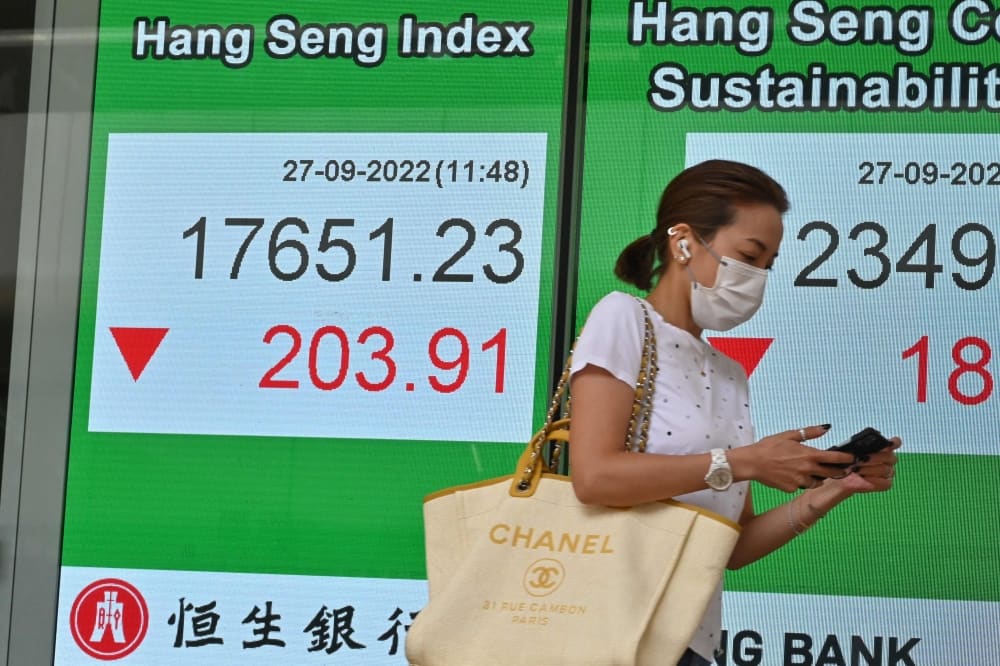
Hong Kong, Shanghai, Sydney, Singapore, Taipei, and Manila all posted significant declines. The Hang Seng Index fell 1.1 percent to 24,941.37, while the Shanghai Composite dropped 0.7 percent to 3,848.17.
The sell-off followed Thursday's session on Wall Street, where the so-called Magnificent Seven group of US tech giants suffered their steepest one-day loss since April 2025's tariff-related volatility. Alphabet plunged nearly 7 percent after disclosing heavy capital spending plans, while Tesla tumbled more than 14 percent. The group collectively shed roughly $800 billion in market value.
AI Investment Scrutiny Intensifies
Investor patience with artificial intelligence spending appears to be fraying. Meta, Microsoft, and Amazon have signaled combined outlays exceeding $700 billion this year on AI infrastructure, chip fabrication facilities, and research. All three are scheduled to report earnings next week.
The question now centers on when these enormous investments will translate into revenue and profit growth. Alphabet and Tesla came under particular scrutiny Thursday for their capital deployment strategies, triggering sharp declines that rippled through global tech supply chains.
Angelina Lai at St. James's Place Asia and Middle East noted that a narrow group of companies has accounted for a disproportionate share of market gains in recent years. "As expectations rise and markets become more selective, future outcomes are likely to depend less on exposure to a theme and more on which businesses can translate investment into sustainable earnings growth and attractive returns on capital," she wrote.
The concern is most acute in Asia's semiconductor sector, which supplies much of the hardware underpinning AI ambitions. South Korean and Japanese chip manufacturers have rallied alongside their US customers over the past two years, but the reversal has been equally swift.
Oil Climbs Past $100 on Middle East Escalation
Energy markets added to the pressure. Brent crude surged 7 percent Thursday, breaching $100 per barrel for the first time since last month's US-Iran truce temporarily eased tensions. On Friday, Brent edged down 0.6 percent to $100.13, while West Texas Intermediate declined 0.6 percent to $91.62.
Fresh hostilities between the United States and Iran, compounded by Houthi attacks on Saudi shipping in the Red Sea, have reignited fears of supply disruption. Yemen's Houthi forces declared a blockade of Saudi ports after striking vessels transporting crude. Saudi Arabia had been routing oil exports through the Red Sea to bypass the Strait of Hormuz, making the new threat particularly significant.
UN Secretary-General Antonio Guterres warned the "situation is getting out of control. It is teetering on the edge of the unimaginable."
Higher oil prices threaten to rekindle inflation, potentially forcing central banks to delay rate cuts or even consider tightening. The recent truce had allowed crude to fall sharply, giving policymakers room to ease borrowing costs. That window now appears to be closing.
Stephen Innes at SPI Asset Management described the dynamic as three separate threats moving in unison. "Oil, rates and AI had fused into a modern market Chimera: crude feeding the inflation inferno, the bond market carrying that heat into higher yields and technology discovering that even the strongest growth story can burn when the cost of capital rises," he said.
Tariff Tensions Return
Washington added to market anxiety Thursday by announcing new tariffs of 10 to 12.5 percent on 60 trading partners, including China and India, citing forced labor concerns. The move follows a Supreme Court ruling in February that struck down several Trump-era duties, prompting the administration to invoke alternative legal authorities.
The president had reimposed a 10 percent levy on imports after the court setback, but that measure expires Friday after a 150-day window. The new tariffs represent an effort to rebuild the tariff structure through different legal channels.
In currency markets, the dollar slipped to 163.78 yen from 163.85. The euro edged up to $1.1385 from $1.1377, while the pound rose to $1.3320 from $1.3315.
Wall Street's Dow Jones Industrial Average closed down 1.0 percent at 51,711.65 Thursday, while London's FTSE 100 fell 0.7 percent to 10,639.17.
Investors now face a crucial week ahead, with major US tech earnings reports likely to determine whether AI spending concerns are justified or overblown. Meanwhile, the trajectory of Middle East conflict and oil prices will shape central bank calculus across the region.
RELATED STORIES
Alibaba Secures $10 Billion in Hong Kong's Largest Follow-On Offering
Cheng Wei-Lun · 2 min
Private Capital Floods Asia's MedTech Sector as Brain Interfaces and Robotics Draw Investors
Priyanka V. Rao · 4 min

Buddy Bites Secures $4.2 Million to Grow Pet Food Subscription Across Asia
Priyanka V. Rao · 2 min

China's Social Security Fund Doubles Offshore Holdings to $86 Billion
Jun-ho Seo · 3 min
Spot something wrong? Email editor@briefasia.com. We log every correction publicly.