Asia · Business
Taiwan's China Steel Deepens Price Cuts as Asian Markets Face Supply Glut
The Kaohsiung steelmaker drops prices NT$800 per tonne for August amid weakening regional demand and dumped inventory diverted from protected markets in Europe and Japan
KEY TAKEAWAYS
- ·China Steel Corp announced an NT$800 per tonne price cut for August domestic deliveries, nearly tripling the NT$300 reduction applied in July across all product lines.
- ·The steeper reduction responds to low-priced steel diverted into Taiwan after EU quota cuts and Japanese anti-dumping duties blocked access to those markets.
- ·China Steel is accelerating trade remedy efforts while raw material costs remain elevated, with iron ore near USD 100 per tonne and coking coal at USD 240 per tonne.
Escalating Price War in Taiwan
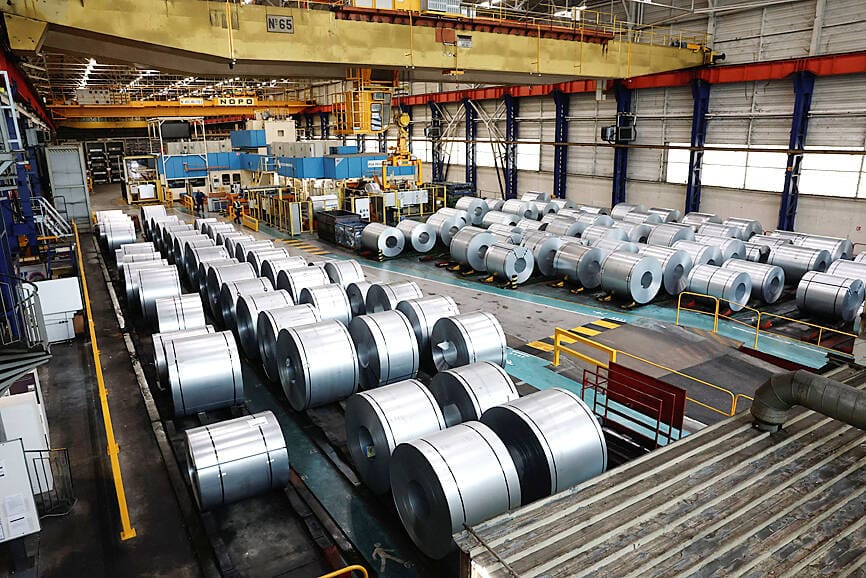
China Steel Corp, Taiwan's dominant integrated steelmaker based in Kaohsiung, announced a NT$800 per tonne price reduction across its entire product range for August deliveries to domestic customers. The cut represents a sharp escalation from the NT$300 per tonne reduction implemented for July shipments.
The price adjustment applies uniformly to the company's full catalogue: hot-rolled coils and plates, standard cold-rolled plates, electro-galvanized coils, galvanized steel coils, and electrical steel products. The move positions China Steel alongside regional competitors who have already begun slashing prices in response to deteriorating market conditions across Asia.
Vietnam's Hoa Phat Group and Formosa Ha Tinh Steel Corp have implemented similar reductions in recent weeks, according to the company's statement. China Steel framed the decision as a strategic effort to preserve its customers' competitiveness by lowering input costs, enabling downstream manufacturers to secure contracts in an increasingly price-sensitive environment.
The Seasonal Downturn Meets Structural Oversupply
Asian steel markets are entering their traditional low season, a period when construction activity slows across much of the region and manufacturing orders taper. But this year's demand softness is compounded by a more troubling structural issue: inventory displacement from protected markets.
China Steel identified a surge of low-priced steel products entering Taiwan after being shut out of the European Union and Japan. Both jurisdictions have recently tightened trade defences for their domestic steel industries. The EU has reduced tariff-free import quotas, effectively shrinking overall supply and pushing prices higher within the bloc. Japan has deployed anti-dumping duties to shield its producers from underpriced imports.
The result is a wave of redirected steel seeking alternative buyers. Taiwan, with its open market and robust manufacturing base, has become an attractive dumping ground for this diverted inventory. China Steel described the influx as "unreasonably low-priced," a characterisation that signals concern about predatory pricing rather than ordinary competitive pressure.
The company confirmed it is accelerating efforts to pursue trade remedies, monitoring the situation closely for potential action under Taiwan's trade defence framework. While no specific measures have been announced, the language suggests China Steel is preparing to petition authorities for anti-dumping investigations or safeguard tariffs if the flood of imports continues to erode domestic pricing power.
Divergent Global Dynamics
The picture outside Asia is markedly different. In the United States, hot-rolled coil prices have stabilised around USD 1,250 per tonne, buoyed by Washington's tariff policies and sustained domestic demand. American steelmakers benefit from a protective trade environment that insulates them from the volatility affecting open markets in Asia.
Europe presents a mixed scenario. While the EU's quota cuts have reduced supply and lifted prices, the bloc's steel sector remains under pressure from broader economic headwinds. The tariff adjustments have provided a floor, but they have not reversed the underlying demand weakness that characterises much of the continent's industrial economy.
Meanwhile, raw material costs remain stubbornly elevated. Iron ore is trading in a narrow band between USD 98 and USD 100 per tonne, while coking coal prices hold steady at approximately USD 240 per tonne. These input costs create a squeeze for steelmakers forced to cut output prices while paying near-peak rates for the materials needed to produce it.
The divergence between stable raw material costs and falling finished product prices compresses margins across the Asian steel industry. China Steel's decision to deepen price cuts despite high input costs suggests the company views market share preservation as more urgent than near-term profitability, a calculation that reflects the severity of the current oversupply.
Taiwan's Steel Sector at a Crossroads
China Steel's pricing strategy carries implications beyond its own balance sheet. As the largest steelmaker in Taiwan, its pricing signals reverberate through the island's manufacturing ecosystem. Lower steel costs benefit downstream industries, including automotive, shipbuilding, construction, and electronics manufacturing. But they also threaten the viability of smaller domestic steel producers who lack China Steel's scale and cost advantages.
The company's reference to trade remedies indicates a recognition that market forces alone may not restore equilibrium. If dumped steel continues to depress prices, Taiwan's steel sector could face a prolonged period of margin compression, reduced investment, and potential capacity exits. The government in Taipei will face pressure to balance its commitments to free trade with the need to protect a strategically important industrial base.
The timing is particularly delicate. Taiwan's broader manufacturing sector is navigating its own challenges, including slower export growth to China and uncertainty around global supply chain realignments. A weakened steel industry would compound these pressures, reducing the competitiveness of manufacturers who rely on domestically produced steel and potentially forcing greater import dependence.
What Comes Next for Asian Steel
The trajectory of Asia's steel markets over the next several months will depend on three variables: the pace of demand recovery as the region exits the seasonal lull, the persistence of diverted inventory flows from protected markets, and the willingness of governments to deploy trade defences.
China Steel's aggressive pricing suggests the company expects conditions to remain difficult through at least the third quarter. If trade remedies materialise in Taiwan or other open Asian markets, the dynamics could shift, redirecting diverted steel to yet another destination or forcing exporters to absorb losses.
For now, the steel industry across Asia is bracing for a prolonged period of oversupply, weak pricing, and compressed margins. China Steel's decision to nearly triple its price cut in the space of a month is a clear signal that the downturn is intensifying, not stabilising.
RELATED STORIES

Taiwan Suppliers Face Delivery Delays as Beijing Slows Critical Materials Clearances
Cheng Wei-Lun · 3 min

Taiwan Consumer Confidence Falls Amid Record Growth Forecasts
Cheng Wei-Lun · 2 min
China Steel Pretax Profit Falls 55% as Asian Demand Weakens
Cheng Wei-Lun · 2 min
Eurasian Security Bloc Convenes as Shein Prices Hong Kong IPO
Cheng Wei-Lun · 3 min
Spot something wrong? Email editor@briefasia.com. We log every correction publicly.