Asia · Politics
Philippine Investment Stalls as Anti-Corruption Drive Halts Infrastructure Pipeline
A sweeping review of public works projects has frozen capital formation for three straight quarters, pulling GDP growth to its slowest pace in years
KEY TAKEAWAYS
- ·Philippine GDP growth slowed to 2.8 percent in the first quarter of 2026, driven by stalled infrastructure projects and surging global energy prices, prompting the World Bank to cut its full-year forecast to 3.7 percent.
- ·An audit revealed roughly 100 billion pesos, or one-fifth of flood-control spending between 2022 and 2025, went to just 15 contractors, triggering a procurement freeze and three consecutive quarters of fixed capital contraction.
- ·Recovery depends on transparent project-approval criteria, credible communication on spending timelines, and resolving the corruption investigation to remove uncertainty from procurement, the World Bank said Monday.
The Cost of Cleaning House
Manila's push to root out procurement fraud has delivered an unintended economic blow. Fixed capital formation has now contracted for three consecutive quarters, dragging the Philippines' first-quarter GDP growth down to 2.8 percent. That marks the slowest expansion in years and has prompted the World Bank to slash its full-year forecast to 3.7 percent, down from an earlier projection of 5.3 percent and well below the 4.4 percent recorded in 2025.
The slowdown stems from two forces: surging global energy prices tied to Middle East tensions and a domestic freeze on infrastructure spending triggered by allegations of systemic corruption. While the former is beyond Manila's control, the latter reflects a deliberate policy choice with consequences that now ripple across both public budgets and private boardrooms.
Government spending on long-term assets dropped roughly 1.3 percentage points of GDP between the first quarters of 2025 and 2026, according to World Bank data released Monday. At the same time, foreign direct investment declined as both domestic and international policy uncertainty rose. Construction, the sector most directly affected, posted the sharpest contraction among all major industries in the opening months of this year.
A Pipeline Frozen by Scrutiny
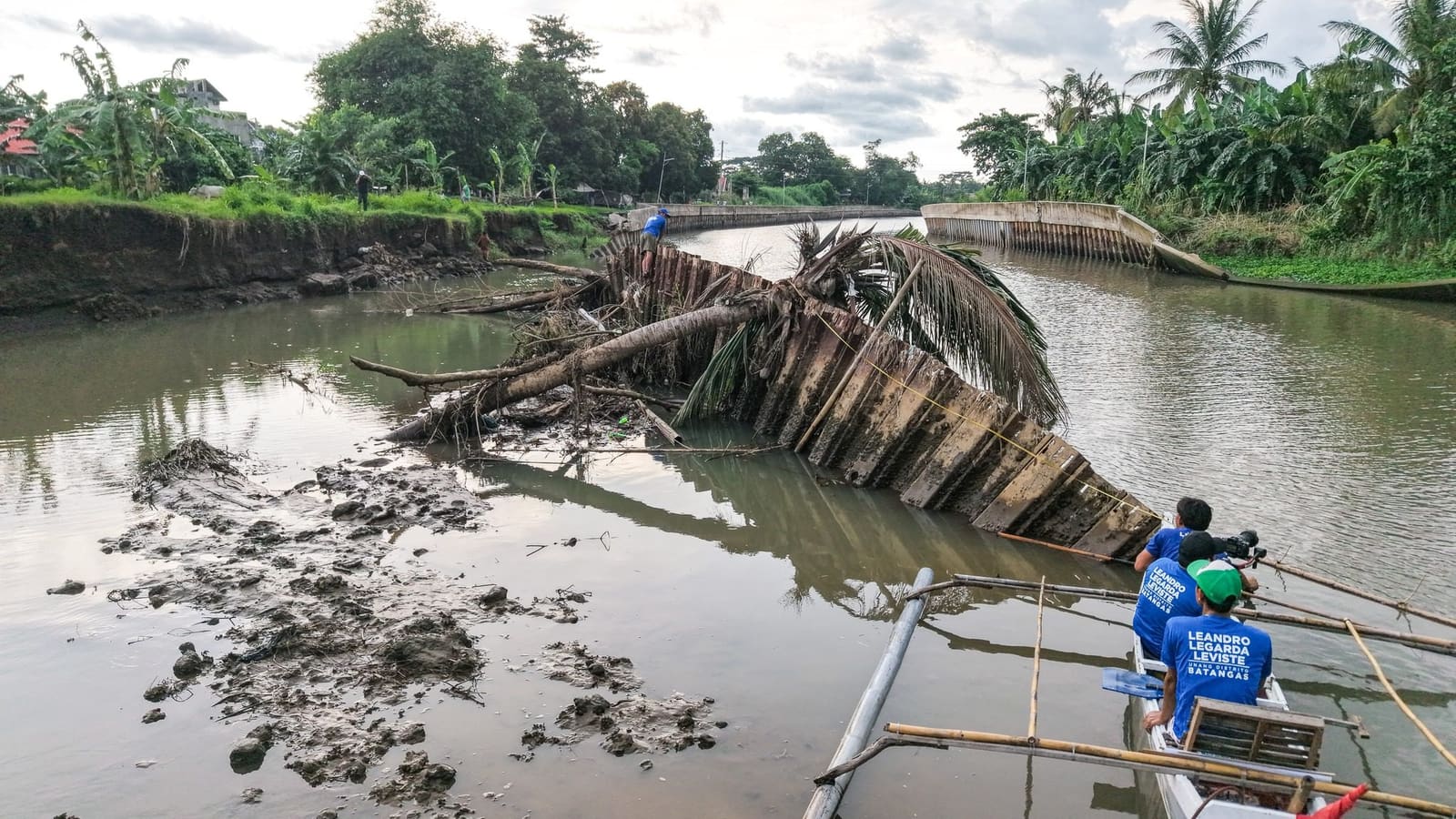
The immediate trigger was a flood-control scandal that surfaced in mid-2025. Authorities disclosed that between July 2022 and May 2025, the government had allocated approximately 545 billion pesos across 9,855 flood-mitigation projects. An initial audit revealed that roughly one-fifth of that spending, around 100 billion pesos, flowed to just 15 contractors. Investigators flagged projects that appeared substandard, lacked proper documentation, or in some cases did not exist at all. Other contracts displayed suspiciously uniform pricing despite varying geographic locations.
The revelations set off a cascade of inquiries. Senate committees opened hearings, the Commission on Audit launched reviews, and the government established an independent infrastructure commission to oversee future procurement. The Department of Public Works and Highways suspended bidding on locally funded flood-control work, effectively halting a major pipeline of projects.
That freeze has extended far beyond flood control. The review now covers how projects are planned, how they enter the budget, and how contracts are awarded. Zafer Mustafaoglu, division director at the World Bank, noted Monday that the uncertainty surrounding procurement has made investors hesitant to commit capital. The result is a sustained contraction in fixed investment, the World Bank's Philippines Economic Update shows, with full-year fixed investment now expected to decline by 0.5 percent.
Short-Term Pain for Long-Term Credibility
The World Bank is not advocating that Manila abandon its cleanup. Strengthening governance around infrastructure spending can improve project quality and, over time, reassure investors that public contracts are awarded under transparent, consistent rules. But the transition carries a near-term cost when agencies must pause work to review planning processes, tighten compliance, and rebuild credibility.
"The key here is to really continue on improving governance of public infrastructure to send a signal to the market, but to do so efficiently and effectively," Jaffar Al-Rikabi, the World Bank's senior country economist, said during Monday's briefing.
If Manila succeeds, the current slowdown may prove temporary. Stronger oversight could lay the foundation for more durable investment growth. But the path forward depends on how quickly the government can restore certainty. The World Bank warns that investor confidence tends to recover more slowly than it erodes. Progress by late 2026 will determine whether the anticipated rebound in public and private investment begins in 2027 or slips further into the future.
What Comes Next
Recovery hinges on three elements, according to the World Bank. First, transparent and consistently applied criteria for project approval. Second, credible communication about when and how infrastructure spending will resume. Third, a resolution of the corruption investigation that removes ambiguity from procurement rules.
The report makes clear that the timeline for restoring public investment depends on governance improvements, not on fiscal capacity. Manila has the budget space to spend; what it lacks is the institutional clarity to deploy that capital without triggering another wave of scrutiny or scandal.
Mustafaoglu emphasized that clear, transparent, and consistently enforced standards would help restart investment and place growth on a stronger trajectory. Until those standards are in place and widely understood, both public agencies and private investors are likely to remain on the sidelines. The question now is whether the government can move quickly enough to prevent a one-year slowdown from hardening into a longer-term drag on the economy.
RELATED STORIES
Filipino Workers Abroad Send Home $3.6 Billion in July
Mariel D. Santos · 3 min

Philippine Capital Inflows Slide as Foreign Firms Curtail Local Lending
Tran Quoc Bao · 3 min
Southeast Asian Firms Overlook Digital Pact Worth USD 2 Trillion
Lim Hui Ying · 4 min
Five ASEAN Members Back Regional Oil Stockpile as Study Nears Completion
Tran Quoc Bao · 3 min
Spot something wrong? Email editor@briefasia.com. We log every correction publicly.