Finance · Banking
Philippine Banks Face Billions in Bond Losses as Rate Hikes Erode Equity
Security Bank, BDO, and other major lenders report material unrealized losses on government securities portfolios, exposing a balance-sheet risk that traditional metrics miss
KEY TAKEAWAYS
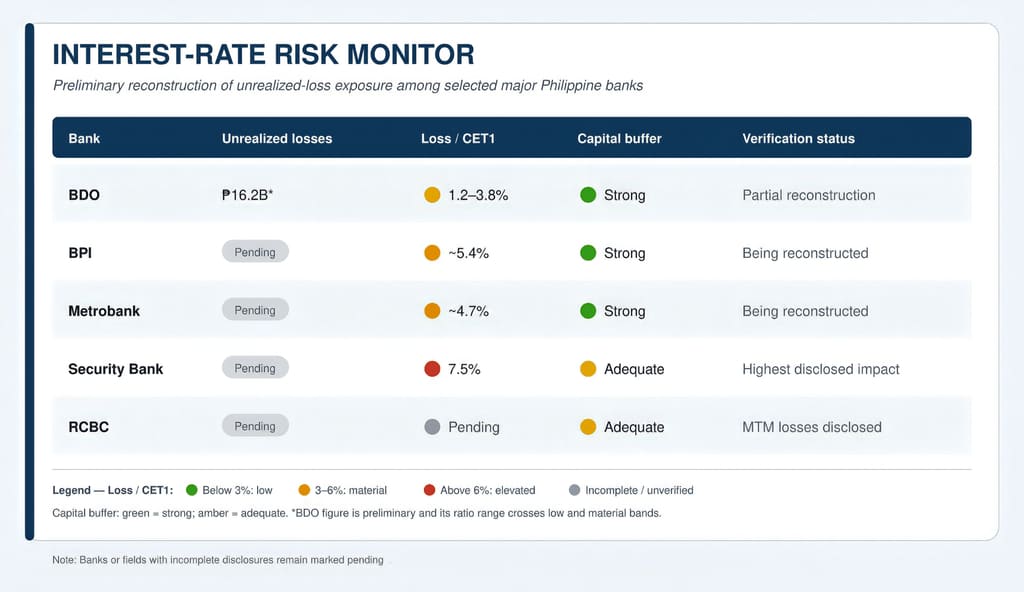
- ·Security Bank disclosed unrealized bond losses equal to 7.5% of its Common Equity Tier 1 capital in early 2026, while BDO reported roughly P16.2 billion in first-quarter losses.
- ·The losses stem from the Bangko Sentral ng Pilipinas' aggressive rate hikes, which pushed government bond yields higher and prices lower, reducing shareholder equity without affecting reported earnings.
- ·Investors should focus on loss intensity relative to capital rather than absolute peso amounts, as banks with thinner capital cushions face greater exposure to interest-rate swings.
Bond Portfolios Take a Hit
Philippine banks are carrying significant unrealized losses on their government bond holdings, a side effect of the Bangko Sentral ng Pilipinas' sharp interest-rate increases over the past two years. Security Bank alone disclosed mark-to-market losses equal to 7.5% of its Common Equity Tier 1 capital in early 2026, up from 3.5% at the close of 2025. Banco de Oro recorded roughly P16.2 billion in unrealized losses in the first quarter of this year, while Bank of the Philippine Islands and Metrobank have also reported measurable impacts.
These paper losses stem from a basic bond-market relationship: when central banks lift policy rates to rein in inflation, yields on government debt rise and prices fall. Because accounting rules require many securities classified as Fair Value Through Other Comprehensive Income to be marked to market each reporting period, the resulting valuation declines flow through Other Comprehensive Income and reduce shareholder equity without touching the income statement. A lender can therefore post strong quarterly earnings while its book value shrinks.
Traditional Metrics Miss the Picture
For years, equity analysts in Manila assessed banks using a standard set of indicators: loan growth, non-performing loan ratios, quarterly profit, and dividend cover. By those gauges, the sector looks robust. Credit quality has improved since the pandemic, capital ratios remain well above regulatory floors, and earnings continue to climb. Yet that framework captures only half the balance sheet. The bond portfolio has become a material source of volatility that traditional credit metrics do not reflect.
A forensic review of the country's largest institutions reveals that almost every major bank now carries unrealized losses on its investment book. The aggregate exposure is large enough to warrant closer scrutiny, even though no single lender appears to be in distress. Philippine banks remain among the best-capitalized in Southeast Asia, and government securities are inherently low-risk assets. The question is not whether these institutions are sound, it is whether investors understand the interest-rate sensitivity embedded in their balance sheets.
Relative Exposure Matters More Than Absolute Size
Comparing peso values of unrealized losses across banks is misleading because larger institutions naturally hold bigger portfolios. A P10-billion paper loss means something different for a bank with P500 billion of CET1 capital than for one with a thinner cushion. The more informative metric is loss intensity: the unrealized decline as a percentage of high-quality capital. That ratio reveals which lenders assumed the most interest-rate risk relative to their ability to absorb it.
CET1 capital consists mainly of shareholder equity and retained earnings and serves as the primary buffer against unexpected losses. Regulators watch this measure closely because it represents the most permanent funding a bank has. A modest paper loss at an institution with a large CET1 base may be immaterial, while the same loss could meaningfully weaken a bank operating with less capital headroom.
Regulatory Relief Complicates the Calculation
The Bangko Sentral ng Pilipinas has granted temporary regulatory relief for certain unrealized losses on qualifying government bonds. Although the accounting losses remain real and continue to appear in financial statements, they receive more favorable treatment when capital adequacy ratios are calculated. The policy is designed to prevent short-term market swings from forcing banks to curtail lending or liquidate securities at fire-sale prices.
The relief is a standard prudential tool, but it creates a gap between accounting capital and regulatory capital. Investors now need to track both figures. A bank may report a decline in book value while its regulatory capital ratio holds steady, or vice versa. That divergence does not signal manipulation; it reflects the way the central bank has chosen to smooth the impact of rate volatility on the financial system.
Liquidity and Duration Determine the Real Risk
The immediate risk to any individual bank depends on two factors: the maturity profile of its bond holdings and the strength of its liquidity position. An institution with ample deposits and stable funding can afford to hold securities until maturity, allowing paper losses to reverse as bonds approach par value. A bank facing liquidity pressure, by contrast, may be forced to sell at a loss if it needs to raise cash quickly.
Duration also matters. Longer-dated bonds are more sensitive to interest-rate movements, so a portfolio skewed toward ten-year or fifteen-year maturities will experience larger valuation swings than one concentrated in short-term paper. The challenge for outside investors is that maturity profiles are not always disclosed in granular detail, making it difficult to assess which institutions carry the most duration risk.
A New Scorecard for a New Cycle
Philippine bank analysis has historically centered on loan books and credit costs. Interest rates were stable for much of the past decade, so bond portfolios attracted little attention. That environment has ended. The tightening cycle that began in 2022 has introduced a new source of balance-sheet volatility, and investors who ignore it are working with incomplete information.
No crisis is imminent. Philippine banks entered the rate cycle with strong capital, low leverage, and conservative underwriting standards. But the scale of unrealized losses now accumulating suggests that a more comprehensive framework is needed, one that tracks not only loan performance and profitability but also the interest-rate exposure buried in investment portfolios. In the next tightening cycle, or the next bout of market volatility, that exposure will determine which institutions prove most resilient.
RELATED STORIES

Broker Veteran Yuchengco Rejects SEC Authority to Force Board Exit at Philippine Stock Exchange
Priyanka V. Rao · 4 min

GCash Expands Financial Literacy Push to Cebu Micro-Retailers
Mariel D. Santos · 4 min

Globe Telecom Sees First-Half Profit Fall 11% on Infrastructure Costs
Priyanka V. Rao · 3 min

SM Prime Holds Flat Earnings in First Half as Cost Growth Offsets Revenue Gains
Mariel D. Santos · 3 min
Spot something wrong? Email editor@briefasia.com. We log every correction publicly.