Technology · AI
Moonshot AI's Kimi K3 Growth Rooted in GTC Architecture Work
The Chinese startup's LLM success stems from training efficiency breakthroughs detailed months before launch, not sudden momentum
KEY TAKEAWAYS
- ·Moonshot AI halted new Kimi K3 subscriptions after user demand exceeded available GPU capacity following the open-source model's benchmark success.
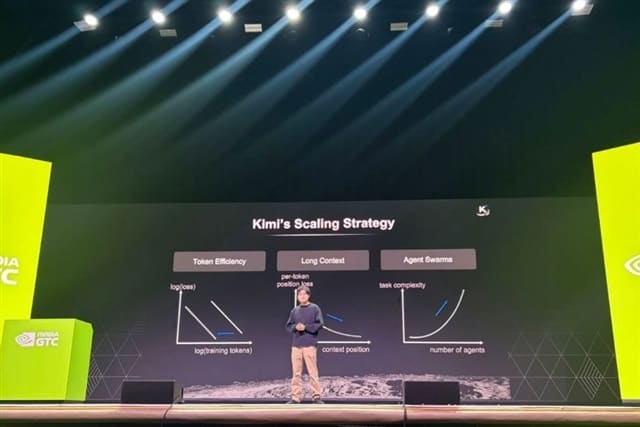
- ·CEO Zhilin Yang presented K3's underlying architecture and training techniques at Nvidia GTC in March 2026, four months before public launch.
- ·The capacity crunch reflects broader infrastructure constraints facing Chinese AI firms navigating chip export controls and scaling inference workloads.
Capacity Constraints Follow Rapid Adoption
Moonshot AI suspended new member subscriptions for its Kimi K3 large language model after user growth outpaced available computing infrastructure. The open-source LLM climbed multiple benchmark leaderboards following its public release, drawing attention from developers and enterprises across Asia.
The Beijing-based startup's capacity crunch reflects broader infrastructure challenges facing Chinese AI firms racing to compete with U.S. counterparts while navigating export restrictions on advanced chips. Moonshot joins a cohort of domestic players including Baidu, Alibaba, and ByteDance building foundation models for Chinese-language applications and regional markets.
GTC Presentation Previewed Technical Foundation
CEO Zhilin Yang outlined the technical underpinnings of K3 during a March 2026 session at Nvidia's GTC conference in San Jose, California, according to Moonshot AI. That presentation detailed improvements in model architecture and training methods that would later enable K3's performance characteristics.
The timeline suggests K3's launch momentum built on systematic engineering rather than spontaneous breakthroughs. Yang's GTC talk occurred roughly four months before the model's public debut, indicating the company had refined its approach well before market release.
Moonshot has not disclosed specific architectural choices or training data volumes for K3. The company's earlier Kimi models emphasized long-context processing, a feature particularly valuable for document analysis and multi-turn conversations in enterprise workflows.
Regional Context for Open-Source Strategy
Moonshot's decision to release K3 as open-source positions the model for adoption by developers who prefer self-hosted deployments or need to customize weights for specialized tasks. Open-source distribution also aligns with Beijing's policy push for domestically controlled AI infrastructure, reducing reliance on proprietary foreign models.
The suspension of new subscriptions, however, underscores the capital intensity of scaling inference infrastructure. Even as Chinese cloud providers expand GPU clusters, demand from concurrent users can quickly exhaust available capacity, especially for models optimized for longer context windows that consume more memory per request.
Moonshot's user influx mirrors patterns seen by other Chinese LLM providers. DeepSeek faced similar scaling pressures earlier this year after its R1 reasoning model attracted global attention, and Zhipu AI temporarily throttled access to its GLM-4 API during peak periods.
Asia's LLM Infrastructure Gap
The capacity bottleneck at Moonshot highlights a persistent gap between model development velocity and infrastructure deployment across Asia. While startups can iterate on architectures and training recipes relatively quickly, securing sufficient GPU allocation from cloud providers or assembling on-premise clusters remains a slower, more capital-intensive process.
Export controls on Nvidia's H100 and H800 chips compound the challenge for Chinese firms. Although domestic alternatives from Huawei and Moore Threads are entering production, performance and ecosystem maturity still lag behind leading U.S. silicon.
Moonshot has not announced a timeline for reopening subscriptions or detailed plans for expanding its inference capacity. The company's next steps will likely involve either securing additional cloud GPU allocations or partnering with regional data-center operators to distribute workload across multiple availability zones.
Benchmark Performance and Market Reception
K3's rise on benchmark leaderboards reflects improvements in both pre-training efficiency and post-training alignment. The model reportedly performs competitively on Chinese-language understanding tasks and multi-step reasoning scenarios, areas where localized models often outperform general-purpose Western LLMs.
Moonshot's emphasis on long-context capability differentiates K3 from smaller, faster models optimized for low-latency chat applications. Enterprises in legal, financial, and research sectors value the ability to process entire reports or codebases in a single prompt, even if inference latency increases.
The open-source release also invites scrutiny of K3's training data and alignment methods. Transparency around data provenance remains uneven across Chinese LLM providers, though regulatory pressure is mounting for clearer disclosures as models enter commercial use.
Yang's GTC presentation offers a rare window into the engineering timeline behind a Chinese AI product launch. As competition intensifies, understanding the lag between technical development and market release becomes critical for investors and partners evaluating startup claims and roadmaps.
RELATED STORIES

LG Pivots to AI-Defined Vehicle Platform as Korea Chases China's Self-Driving Lead
Jun-ho Seo · 3 min

China's Auto Chip Race Shifts to Volume as Horizon Robotics Crosses 15 Million Units
Jun-ho Seo · 3 min

China's Chip Makers Split Three Ways Beneath the Revenue Growth
Tran Quoc Bao · 3 min
JCET Eyes $968 Million to Scale AI Packaging Lines
Tran Quoc Bao · 3 min
Spot something wrong? Email editor@briefasia.com. We log every correction publicly.