Lifestyle · Fashion
Lam Gia Khang Is Building a House That Will Not Need Him
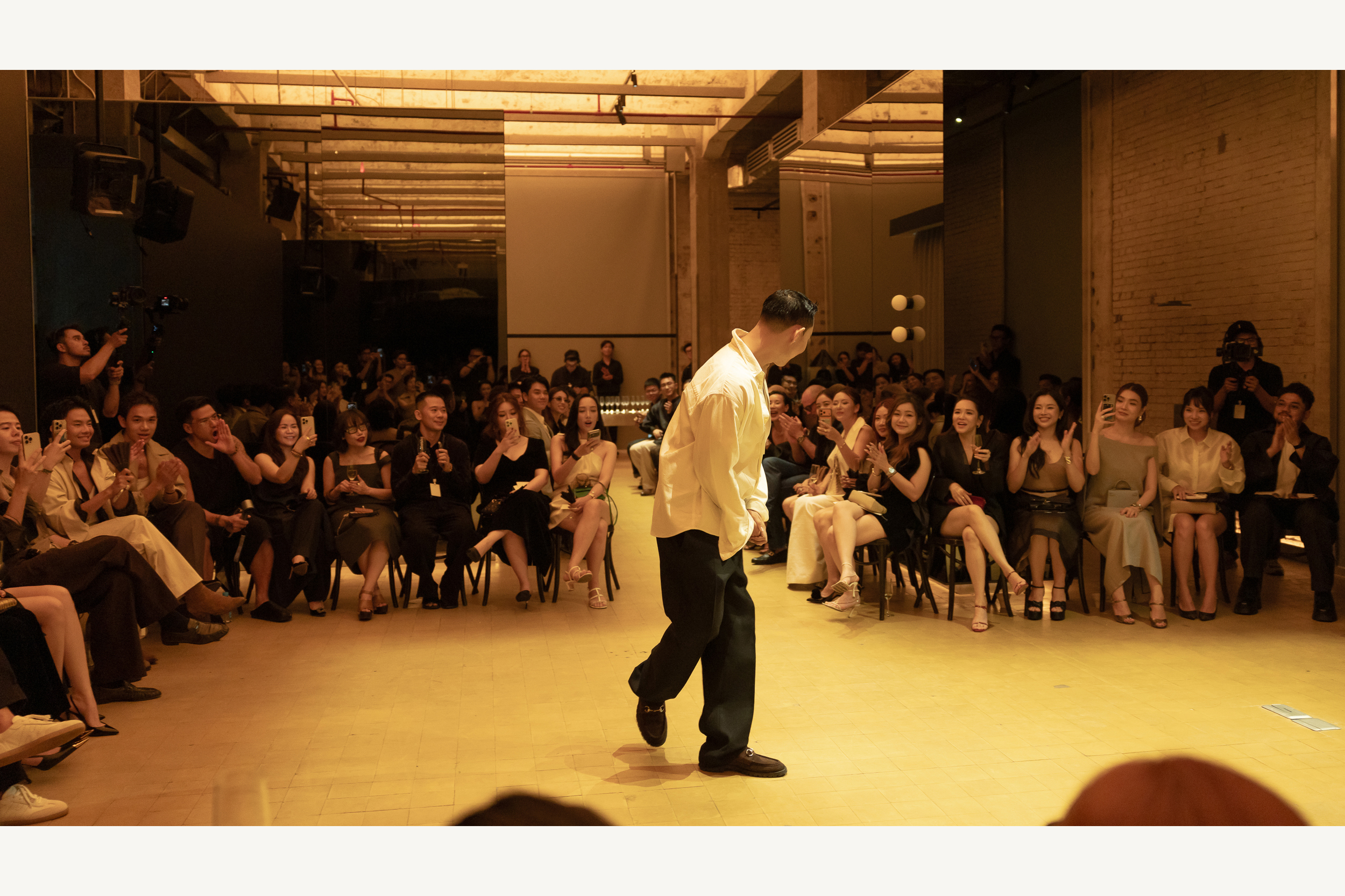
Gia Studios opens its first store abroad at the end of this year. Its founder spends almost none of a forty question conversation on that milestone, and almost all of it on the harder question underneath: whether a Vietnamese brand can hold on to what it has built.
KEY TAKEAWAYS
- ·This is not the usual Vietnamese-fashion story about magazine covers, Paris showrooms and being seen. Lam Gia Khang shifts the subject to ownership: of margin, of the right to name a fabric, and of a house that can outlast its founder.
- ·He declines the "first Vietnamese brand with a store abroad" label, and across a 40-question interview he refuses to answer seven times, three of them to shield his Tan Chau weavers. The piece is upfront that most of his figures cannot be verified, which is exactly why the restraint carries the story.
- ·It all resolves into one wager: price a Vietnamese shirt at US$450 to 650 and be judged like a Japanese or Belgian label, not on a separate curve, while building a studio whose standard outlives any one pair of hands. Asked who will design after him, he says only, "Not yet."
A flattering claim has been circulating in the Vietnamese press. Gia Studios, it says, is the first Vietnamese fashion brand to open a store overseas. We asked Lam Gia Khang whether he wanted his name standing behind that sentence.
"I do not think I need the word first to make it meaningful," he answered. If it can be verified, print it. If it cannot, he would rather be remembered for a good store than for a title he cannot prove himself.
In an industry where almost every press release contains at least one claim to being first, that answer says more about him than the title he turned down. It also opens onto the thing that makes this conversation different from everything written about him over the past six months.
For eight years, most of what has been written about Vietnamese fashion has been a story about visibility. Who appeared on which cover, who got into a Paris showroom, which fabric caught a buyer’s eye. This conversation runs somewhere else, which is why it is worth printing. It is barely about being seen at all. It is about ownership: of margin, of decision rights inside a capital structure, of the right to name a material, and of a system that can outlive the person who built it.
Running alongside that is a discipline the industry rarely shows. Across forty questions, there are seven places where he stops and declines. Three of them protect somebody else.
More than a hundred people
The Gia Studios workshop now employs more than a hundred, and that number marks the point where the old model ran out of room. "I used to walk into the workshop and know almost exactly who was making which garment," he says. "The scale is different now. It is no longer the family’s tailoring shop. It is becoming the brand’s craft workshop."
The last word in the house does not necessarily belong to the designer. He decides proportion and image, but his mother or his aunt can look at a seam and know whether it is right. Then he adds a third party to the argument. Once fabric goes onto the mannequin, its drape and its temperament can force everything to change. At that point the material has the final say.

Asked how many garments one tailor completes in a week when that tailor owns the piece from first cut to last stitch, he will not answer. An average would mislead more than it explains. Some of the plainest looking pieces are difficult precisely because the labor inside them has to stay invisible to the person wearing it. Asked how much more that method costs than a production line, he says significantly more, and declines to name a ratio without the figures in front of him.
What the method buys, he describes concretely. When something goes wrong, the tailor knows where it went wrong. When the garment is good, the tailor understands why.
The model has a ceiling and he admits it. Past that point, the pieces requiring the highest skill would keep the current method while other groups moved to a different process. He does not know where the ceiling sits and will not invent a number. What follows is a business proposition rather than an aesthetic one.
"If growth forces Gia Studios to abandon the very method that creates its quality, then to me the problem is the rate of growth. I want to expand capability before expanding volume."
The youngest tailor on the floor is twenty five. What he watches, though, is the distance between that person and the most skilled hands in the room, because the size of that gap tells him how much time is left to pass the craft along. It is the real clock inside a workshop like this, and it appears in no industry report.
He draws a hard line between teaching someone to sew and training someone to understand clothes. The second takes years, and its content is not stitching. It is the feel of tension in a fabric, the way a material behaves on a body, proportion, and the space between a garment and the person inside it.
If his mother and aunt stopped tomorrow, the senior tailors would keep the place running. He does not consider that a good answer. A brand that survives only because a few individuals are irreplaceable has not built a system. What he wants to transfer is not anyone’s position. It is their standard.
Who gets to name a fabric
In July, a sharp argument surfaced in the Vietnamese press. Lanh My A is a lacquered silk from the Mekong Delta, traditionally dyed with the fruit of the mac nua tree in a process that takes weeks of repeated immersion and sun drying. The question raised was whether cloth that skips the mac nua dye can still carry the name. Nobody was accused of anything. The argument simply landed where Gia Studios stands, because Lanh My A anchors the Spring Summer 2026 collection and is the thing that international buyers now recognize the brand by.
In that collection the silk is thinner and lighter than tradition dictates. The trade reads this two opposite ways, as a liberation of the material or as the removal of the thing that made it. He comes down firmly on the first.
"I do not think preservation means freezing a material at one moment in time," he says. "If we keep a material unchanged only because we are afraid of losing it, sometimes we turn something living into an artifact."
He also separates the work. Tan Chau adjusts the properties of the cloth, its weight and its surface. Once the material reaches the workshop, Gia Studios experiments further with its own techniques. His reason for wanting that boundary visible is not legal. It is about credit. What belongs to the weavers should be credited to the weavers.
Asked the direct question, whether the cloth he took to Paris was dyed with mac nua throughout, his answer moves elsewhere. The name Lanh My A, he says, is tied to origin, material and the technique that produces it. If Gia Studios ever changed those elements enough that the cloth no longer met that definition, he would have to be honest enough to call it something else. That is a strong commitment. It is not a confirmation. The question was about a specific bolt of cloth and the answer is about a principle of naming, and we record both.
On Paris buyers now asking first whether there is Vietnamese silk this season, he separates two moments. At first it was recognition. But if in five years they are still only asking about Vietnamese silk and not whether the shirt is any good, the recognition becomes a box. He wants origin to open the door. He does not want it to be the only reason anyone stays.
The shortest answer of the whole exchange falls here. Asked what would remain in three years if the supply dried up, he replied: then Gia Studios still has to remain. If you remove Lanh My A and the brand has nothing left to say, that is a failure. The DNA has to sit deeper than a fabric.
The label, and the price it is allowed to carry
Prejudice about where a garment is made is real, he confirms, especially in the early years. The mechanism that breaks it is physical rather than rhetorical. Once a buyer handles the product and looks at the construction, the seams and the finishing, the conversation changes.
Then he names the harder part. The challenge was never proving that Vietnam can make a good product, because Vietnam proved that long ago. The harder thing is proving that the quality has the right to be priced accordingly.
That gap has narrowed, and the indicator he uses to measure it is not revenue. It is how much explaining he still has to do. After enough consistent seasons, the buyer’s question shifted from whether Vietnam could make this to what comes next.
He will not publish the wholesale share of retail price, but the way he weighs the two channels is not the way a creative director usually does. Direct retail carries the better margin and also the entire inventory risk and the burden of finding the customer. Wholesale delivers distribution and credibility at a thinner margin. The two do different jobs.
Gia Studios is profitable, he says, and no longer depends on family capital. Neither claim can be verified from outside; this is a private company that publishes nothing. But even taken purely as a statement, it is unusual. Very few designers in Vietnam discuss profit, and almost none discuss their capital structure. The notable part is his reason for caring.
"Profitability matters not because it is an achievement to talk about, but because it gives you the right to say no to opportunities that would grow the brand faster and weaken it over time."
The family money, he says, is finished. "There came a point when Gia Studios had to stop being treated as a child of the family and start being accountable as a business." What he took from the family was larger than capital anyway: the craft, the standard, and a way of looking at clothes.
The store
The first international store is due to open at the end of this year. He will not name the city yet, and says it was not chosen for being the largest market. It was chosen because Gia Studios already has a customer base there.
His reason for opening it is framed as a question rather than a sales target. What is Gia Studios when it controls the entire experience? What he wants to govern is the distance between the moment somebody walks into a room and the moment they touch a garment.
-400x267.jpg?prefix=brief-asia)
Most of the capital comes from retained earnings, with additional funding from a long term strategic partner. His condition on that structure is that it must not cost the brand its authority over product, image and direction. On operations, he works with a local partner in the areas where they understand the market better.
Asked whether he would close the store or hold it if it had not broken even in two years, he picks neither, and instead sets a limit on his own patience. Patience is not the same as stubbornness.
What this changes
For the weaving households of Tan Chau, the concrete change is not attention. It is order horizon. Gia Studios tries to commit far enough ahead that producers can plan a production schedule, rather than buying in the seasons it needs the cloth and disappearing in the seasons it does not. A household that can plan across several seasons can invest in looms and in an apprentice.
The standard he sets himself is a demanding one. A brand that makes a material desirable without making the craft economically viable has not done enough. There is a knot here we cannot untie. He declines to publish annual yardage because the figure would reveal too much about his suppliers. The reasoning is protective and sound, and it also means the scale of what Gia Studios contributes to Tan Chau cannot be audited from outside.
Inside the workshop, the thing running down is that gap he described. If the standard does not transfer from the senior tailors to the twenty five year olds in time, the value the brand has accumulated evaporates within a generation, because it is underwritten by skill rather than by a logo.
For the designers coming up behind him, his largest contribution here is a refusal to be a template. "I do not think the next generation has to work like Gia Studios. In fact I hope they do not." A healthy industry, he argues, needs room for a twenty person workshop, a two thousand person factory, a textile mill and an independent designer. What needs to scale is not his method. It is the standard.
Forced to choose the single thing Vietnam lacks most, he picks neither mills nor schools. He picks patient capital, because both of those take years to build, and because moving a designer from one good collection to an actual house takes longer still. What the country lacks, in his reading, is not manufacturing capacity but ownership across the value chain, from material and design through distribution to the brand itself.
A smaller shift is happening inside the boutique itself. Since mid August, three floors of the store have been given over to Uyen Chuyen, an exhibition by the artist Lam Na under La Galerie, an initiative the brand uses to host contemporary artists. Selling space converted into exhibition space is a real cost, and in a city short on independent art spaces that reads as a transfer of resources rather than as publicity.
All of it eventually has to resolve into one verifiable number. A Gia Studios shirt currently sells for roughly 450 to 650 dollars on an international shelf, per the figure he supplied. The number is less interesting than the condition attached to it: at that level, customers should judge the garment by the same standards they apply to a Japanese, Belgian or Italian label, not by a separate standard reserved for Vietnam. If a Vietnamese brand can hold that across many seasons, the export is no longer garments. It is pricing power.
The seven refusals
Placed side by side, the seven points where he stopped describe a system rather than random evasion.
· How many garments one tailor finishes in a week. Declined because an average would mislead.
· How much more the method costs than a line. Declined for lack of exact figures.
· The number and names of the Tan Chau weaving and dyeing households. Declined without their consent.
· Annual yardage. Declined because the figure would expose his suppliers.
· Wholesale as a share of retail. Held private with no elaboration.
· The city of the international store. Not disclosed until everything is settled.
· The claim to being the first Vietnamese brand with a store abroad. Declined outright.
Three of those protect third parties. Two are refusals to estimate without data. One is operational. And one turns down something most people in this industry would accept without a second thought.
Readers should have the other half of that. Most of the numbers in this piece come from a single source and cannot be audited externally, which makes them the founder’s statements rather than verified facts. The consistency of his refusals is worth noting. It is not a substitute for verification.
Not yet
In 2018 he said he did not want the brand to grow old alongside him, and that someone else would design after him. Eight years later, asked whether that person has a name, he answers with one word.
Not yet.
But the way he thinks about succession has changed. He used to picture somebody eventually sitting in his chair. Now he is not sure a house should be built that way. What is being built instead is a design studio with a shared language, a shared system of pattern blocks and a shared standard, so that the brand does not rest entirely on one person’s instinct.

If he were away for a month, he says, the collection would still ship. He uses exactly that as the test of the last eight years. If he disappeared for a month and the collection stopped with him, what he built is a studio orbiting a designer rather than a house.
On a fifth generation in his own family, he refuses to assign the obligation. What he wants is a fifth generation of the craft, not necessarily one carrying his surname. If a young person from outside the family learns what they know and one day does it better, that counts as continuity.
The last thing we asked was whether there is a question he has been waiting for that nobody has put to him. The one he asks himself was nowhere in the forty we had prepared.
If one day Gia Studios no longer needs him, will he be sad?
He has spent eight years building a brand meant to outlast him, he says, and if he actually succeeds there will certainly come a day when it stops needing him the way it needs him now. Then he stops. He does not know yet how that will feel.
Editor’s note
This piece is based on written answers Lam Gia Khang provided to forty questions submitted by Brief Asia in August 2026, together with previously published material. Vietnamese names and terms appear without diacritics in this edition for international readability.
· Brand age: Gia Studios launched in May 2018, making it eight years old in 2026. A six year figure that appeared in the Vietnamese press refers, per the brand, to its international market development rather than its founding.
· The Spring Summer 2026 venue is confirmed as the Saigon Central Post Office. A widely reprinted description of the building as 145 years old does not match its completion date, and the brand itself asked that the figure be independently verified, so this piece does not use it.
· The collection comprised 57 looks, per Harper’s Bazaar Vietnam in May 2026, confirmed by the brand.
· The brand states that Emma Stone wore Gia Studios during a Good Morning America appearance in 2025. Brief Asia has not verified this independently and does not rely on it.
· Names of the Tan Chau households and the location of the international store are withheld at the brand’s request.
· Retail pricing, profitability and capital structure figures were supplied by the subject and cannot be independently verified, as this is a private company.
· Reference material: Harper’s Bazaar Vietnam (May and June 2026), Thanh Nien (June 2026), Tuoi Tre (July 2026), ELLE Vietnam (August 2026 and October 2022), Tatler Asia, South China Morning Post (April 2025).
RELATED STORIES

Vietnam's Wealthy Shift Focus From Making Money to Managing It
Priyanka V. Rao · 3 min

The cloth Thanh Lam sings in
Manh Khang · 6 min

Canadian Lobster Imports Surge in Vietnam on Price Advantage
Priyanka V. Rao · 3 min
.jpg?prefix=brief-asia)
Vietnam’s Tourism Boom Outruns Its Earnings as Industry Is Urged to Put Value Before Volume
Simon Ng · 11 min
Spot something wrong? Email editor@briefasia.com. We log every correction publicly.