Travel & Dining · Trends
China's C919 Jet Makes International Debut on Beijing-Ulaanbaatar Route
Air China's first cross-border commercial flight with the domestically produced narrowbody signals Beijing's push to break the Boeing-Airbus duopoly in Asia's aviation market
KEY TAKEAWAYS
- ·Air China operated the first international commercial flight of the domestically produced C919 narrowbody jet on a Beijing to Ulaanbaatar route with 111 passengers.
- ·The deployment targets Belt and Road markets as Comac builds operational experience before expanding to competitive international gateways and securing Western regulatory certification.
- ·Over 17,000 new aircraft will be delivered to Asia-Pacific carriers in the next two decades, with China representing nearly half that demand and a key battleground for narrowbody market share.
First Cross-Border Service
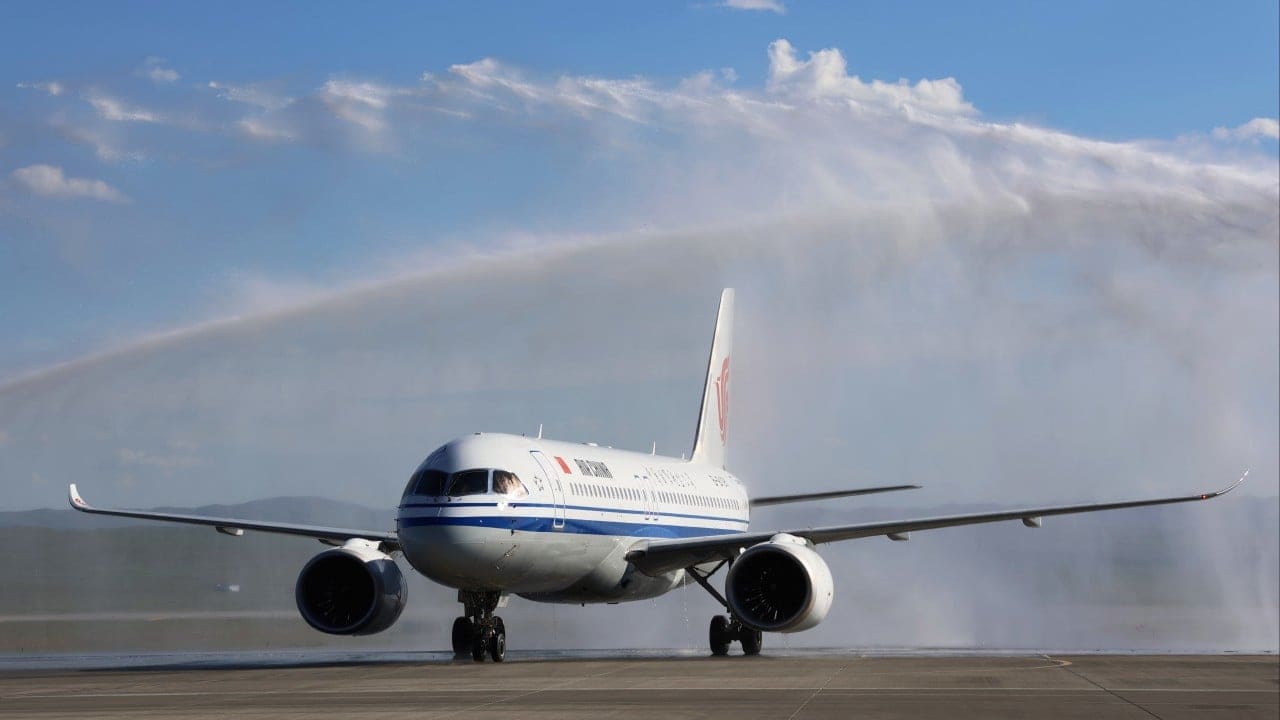
Air China flight 723 departed Beijing Capital International Airport on Wednesday carrying 111 passengers to Ulaanbaatar, Mongolia, according to the airline. The service marked the first time Commercial Aircraft Corporation of China's (Comac) C919 narrowbody jet operated a scheduled international route since entering commercial service.
Howard Deng, a business traveler on the flight, described the experience as "very smooth" and said he was unaware of the aircraft's significance until boarding. The flight represents a tangible step in China's decades-long effort to develop indigenous civil aviation capability and reduce dependence on Western suppliers.
Comac delivered its first C919 to China Eastern Airlines in December 2022, with the type entering revenue service on domestic routes in May 2023. The aircraft has since accumulated operational experience on trunk routes connecting major Chinese cities including Shanghai, Beijing, Chengdu, and Guangzhou.
Asia's Aviation Build-Out
The Beijing-Ulaanbaatar deployment is strategically timed. Mongolia sits within China's Belt and Road Initiative sphere, and the route serves both business and tourism traffic between the two neighbors. Air China's decision to allocate the C919 to this corridor rather than a more prominent international gateway suggests the carrier is building operational confidence incrementally before expanding to higher-profile markets.
Asia-Pacific airlines are expected to take delivery of more than 17,000 new aircraft over the next two decades, according to Boeing's latest market outlook. China accounts for nearly half that demand. If Comac can capture even a modest share of the regional narrowbody market, the commercial implications for Boeing's 737 and Airbus's A320 families are significant.
The C919 competes directly with the 737-800 and A320neo in the 160- to 190-seat segment. Comac has reported over 1,000 orders for the type, though the majority come from Chinese carriers and leasing companies. International sales remain limited, in part because the aircraft has not yet secured certification from the U.S. Federal Aviation Administration or the European Union Aviation Safety Agency, restricting its ability to operate into those jurisdictions or appeal to carriers prioritizing regulatory commonality.
Technical and Supply-Chain Realities
The C919 relies heavily on Western suppliers for critical systems. CFM International, a joint venture between General Electric and France's Safran, provides the LEAP-1C engines. Honeywell, Collins Aerospace, and other U.S. and European firms supply avionics, flight controls, and other subsystems. This supply-chain reality has made the program vulnerable to export-control measures, particularly as U.S.-China technology competition intensifies.
Comac is working to develop a fully indigenous powerplant, the CJ-1000A, though certification and production timelines remain uncertain. Until that engine enters service, the C919's positioning as a "domestically produced" aircraft remains qualified.
Operational feedback from China Eastern and other early operators has been cautiously positive. Dispatch reliability and maintenance support are improving as the fleet matures, though the aircraft's in-service track record is still measured in months rather than years. Airlines outside China are watching closely, particularly carriers in Southeast Asia, Central Asia, and Africa where Chinese policy banks and development finance institutions hold influence.
What Comes Next
Air China has not disclosed whether the Ulaanbaatar route will remain permanently allocated to the C919 or if the deployment is a trial. The carrier operates a mixed fleet on the route, and scheduling flexibility will depend on aircraft availability and utilization targets.
The more consequential question is whether Comac can extend the C919's international footprint beyond Belt and Road corridors into competitive markets where airlines have genuine choice. Securing customers in Southeast Asia, the Middle East, or Latin America would signal that the aircraft is winning on economics and performance, not just policy alignment.
For now, the Beijing-Ulaanbaatar flight is a proof point. It demonstrates that the C919 can operate cross-border services and handle the regulatory and operational requirements that come with international flying. Whether that translates into a sustainable challenge to the incumbents will depend on cost, reliability, and Comac's ability to build a global support network that rivals what Boeing and Airbus have spent decades constructing.
RELATED STORIES
China's State Airlines Face $1.3 Billion Loss as Fuel Costs Climb
Cheng Wei-Lun · 3 min

DeepSeek Ships V4 Pro API With Million-Token Context and Response Streaming
Cheng Wei-Lun · 4 min

Insta360 Enters Mirrorless Camera Market With Two Unconventional Models
Cheng Wei-Lun · 3 min

DeepSeek Raises API Prices by Up to 1,100 Percent for V4 Models
Cheng Wei-Lun · 2 min
Spot something wrong? Email editor@briefasia.com. We log every correction publicly.