Finance · Deals
ABS-CBN Raises $6 Billion in Emergency Recapitalization as Losses Mount
The Philippine media giant secures rescue funding from Hong Kong-backed investors while accumulated deficits reach $6 billion and creditors extend deadlines

KEY TAKEAWAYS
- ·ABS-CBN Corporation secured P6 billion in emergency capital from I&C Holdings and Lopez family entities, issuing 1.6 billion shares at P3.65 each to address P45.5 billion in accumulated losses since 2020.
- ·Hong Kong advisory-backed I&C Holdings will hold 38% of the expanded equity, becoming the largest single shareholder while the Lopez family retains 47% and public shareholders are diluted to 15%.
- ·The broadcaster owes P11.8 billion to creditor banks and has negotiated loan extensions while selling Quezon City property to Ayala Land, with profitability projected within 18 months under the content-led model.
Emergency Capital Injection
ABS-CBN Corporation has closed a P6 billion emergency recapitalization package designed to stabilize the financially distressed Philippine broadcaster, which has been operating under regulatory going-concern warnings since 2025.
The funding comprises P3.5 billion from I&C Holdings Corp., P2.2 billion pooled from three branches of the Lopez family through Crème Investment Corp., Mantes Corp., and Presta Holdings, and P300 million from Lopez Inc. The capital raise will issue 1.6 billion new ABS-CBN shares at P3.65 per share, according to the company's August 10 filing.
I&C Holdings, registered in February 2026 and backed by senior executives from Hong Kong-based Fortman Cline Capital Markets, will become the single largest individual shareholder with approximately 38% of the expanded equity base. The Lopez family will retain a combined 47% stake, while public retail shareholders will be diluted to 15%.
Five Years of Accumulated Deficits
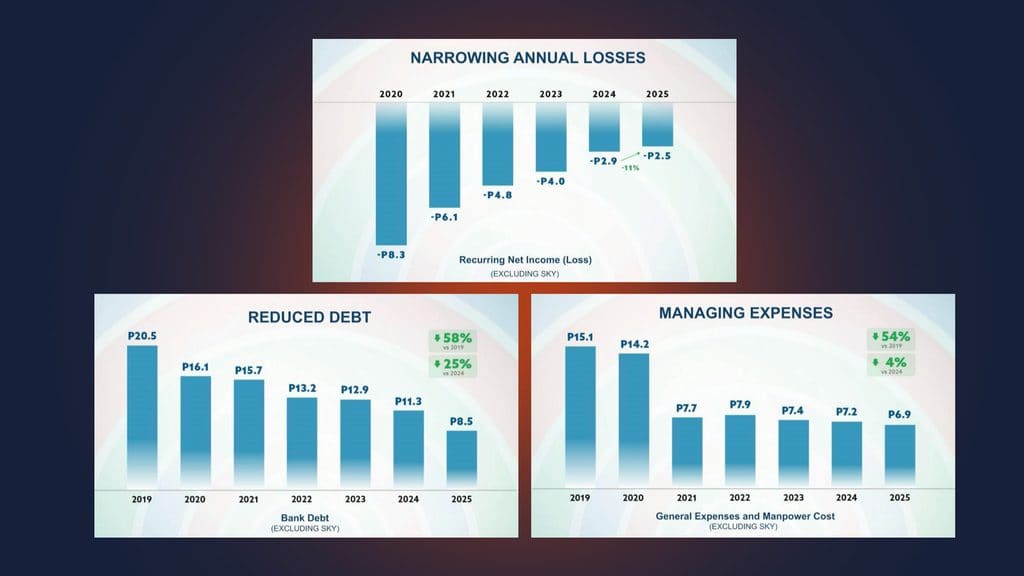
ABS-CBN has posted accumulated losses of roughly P45.5 billion between 2020 and 2025, erasing its entire cash surplus and leaving the company with a retained earnings deficit of P6 billion. The media network's August 2026 financial report showed first-half net losses more than doubled to P1.83 billion, an increase of P852 million over the same period in 2025, driven by weak advertising revenue and fewer commercial events.
Both the company's 2025 annual report and 2026 financial filings carry explicit accounting warnings stating "material uncertainty exists that may cast significant doubt on the Group's ability to continue as a going concern."
The broadcaster, which lost its terrestrial broadcast franchise in 2020, now operates primarily as a content producer. Together with its subsidiary Sky Cable, ABS-CBN owes an aggregate P11.8 billion to creditor banks including Bank of the Philippine Islands and UnionBank of the Philippines. The company also carries outstanding retirement and separation pay obligations to thousands of employees laid off following the 2020 shutdown.
Debt Extension and Asset Sales
Major creditors have agreed to extend loan payment deadlines as part of the rescue arrangement. ABS-CBN has already sold portions of its historic Broadcast Center in Quezon City to Ayala Land Corporation to raise initial debt payments.
Under the recapitalization terms, a significant portion of the newly injected funds will address immediate financial obligations, including outstanding employee separation packages and near-term debt maturities. Management has allocated remaining capital toward digital content production, formally abandoning pursuit of a new broadcasting franchise.
The investment firm backing I&C Holdings is expected to provide financial restructuring expertise and asset-monetization strategies as ABS-CBN transitions from a traditional broadcaster into what executives describe as a pure-play digital content house.
Management Continuity and Market Reaction
The governance structure will remain largely unchanged. Chairman Martin L. Lopez and president Carlo L. Katigbak will retain their positions, while veteran media executive Charo Santos-Concio will return to the board.
When the recapitalization was announced on August 10 with a buy-in price of P3.65 per share, ABS-CBN stock jumped 12.6% to P4.11, signaling initial market confidence despite the price trading above recent book values. However, shares retreated to P3.84 by August 18, down 6.57% from the post-announcement high.
The transaction represents a shift in the Lopez family's investment approach. Eugenio "Gabby" Lopez III sold his family's 25.68% shareholding in Lopez Inc., the clan's apex holding company, to tycoon Ramon S. Ang, redirecting proceeds toward the direct recapitalization of ABS-CBN rather than maintaining exposure through layered holding structures.
Content Pivot and Profitability Timeline
ABS-CBN now derives 84% of its revenue from content production and distribution, a structural shift from its legacy broadcast model. Financial analysts consider the company "rescuable as a content enterprise," with projections suggesting the P6 billion injection could stabilize operations and lead to structural profitability within an 18-month window, according to market consensus.
I&C Holdings is led by Daniel D. Ibasco and Gary Emerson P. Cheng, co-founders of Fortman Cline Capital Markets. Ibasco previously held senior roles at Bear Stearns, Hambrecht & Quist, and Bank of Boston, while Cheng spent a decade at J.P. Morgan before serving as president and CEO of Amalgamated Investment Bancorporation.
The recapitalization marks one of Southeast Asia's larger private media rescue packages in recent years, coming as traditional broadcasters across the region grapple with declining linear television audiences and the structural shift toward streaming and digital distribution. The outcome will test whether legacy media brands can successfully pivot to content-led business models while managing legacy debt and cost structures built for a different era.
RELATED STORIES
Philippine Broadcaster Prepares Board Expansion Ahead of $105 Million Equity Raise
Priyanka V. Rao · 4 min
ABS-CBN's Losses Double as Media Giant Awaits P6 Billion Lifeline
Mariel D. Santos · 3 min

Philippine Fintech Billease Taps PNB for Billion-Peso Receivables-Backed Facility
Priyanka V. Rao · 3 min

Philippine Stocks Fall 1.7 Percent as Currency Hits Record Low
Priyanka V. Rao · 4 min
Spot something wrong? Email editor@briefasia.com. We log every correction publicly.