Finance · Story
Indian Equities Face Tepid Open as Middle East Tensions Flare
Gift Nifty signals a cautious start for Mumbai trading while Asian peers retreat on renewed US-Iran hostilities and chip-sector weakness
KEY TAKEAWAYS
- ·Gift Nifty traded at 24,087, a 15-point discount to Nifty futures, signaling a subdued Monday open for Indian equities after a holiday closure.
- ·Asian markets declined as US-Iran hostilities reignited over the weekend, pushing Brent crude up 0.67% to $72.51 and pressuring regional risk sentiment.
- ·Goldman Sachs raised India's fiscal 2026 GDP growth forecast to 6.5% from 6.1%, citing improved prospects following recent diplomatic progress.
Pre-Market Signal Points to Cautious Start
Gift Nifty traded around the 24,087 level early Monday, marking a discount of approximately 15 points from the previous close of Nifty futures. The pre-market indicator suggests Mumbai's benchmark indices will open on a subdued note after a holiday closure on Friday for Muharram.
The Sensex had closed Thursday at 77,100.47, up 109.25 points or 0.14%, while the Nifty 50 settled 34.35 points higher at 24,056.00. Both indices recorded modest gains despite profit-booking at intraday peaks.
Regional Bourses Under Pressure
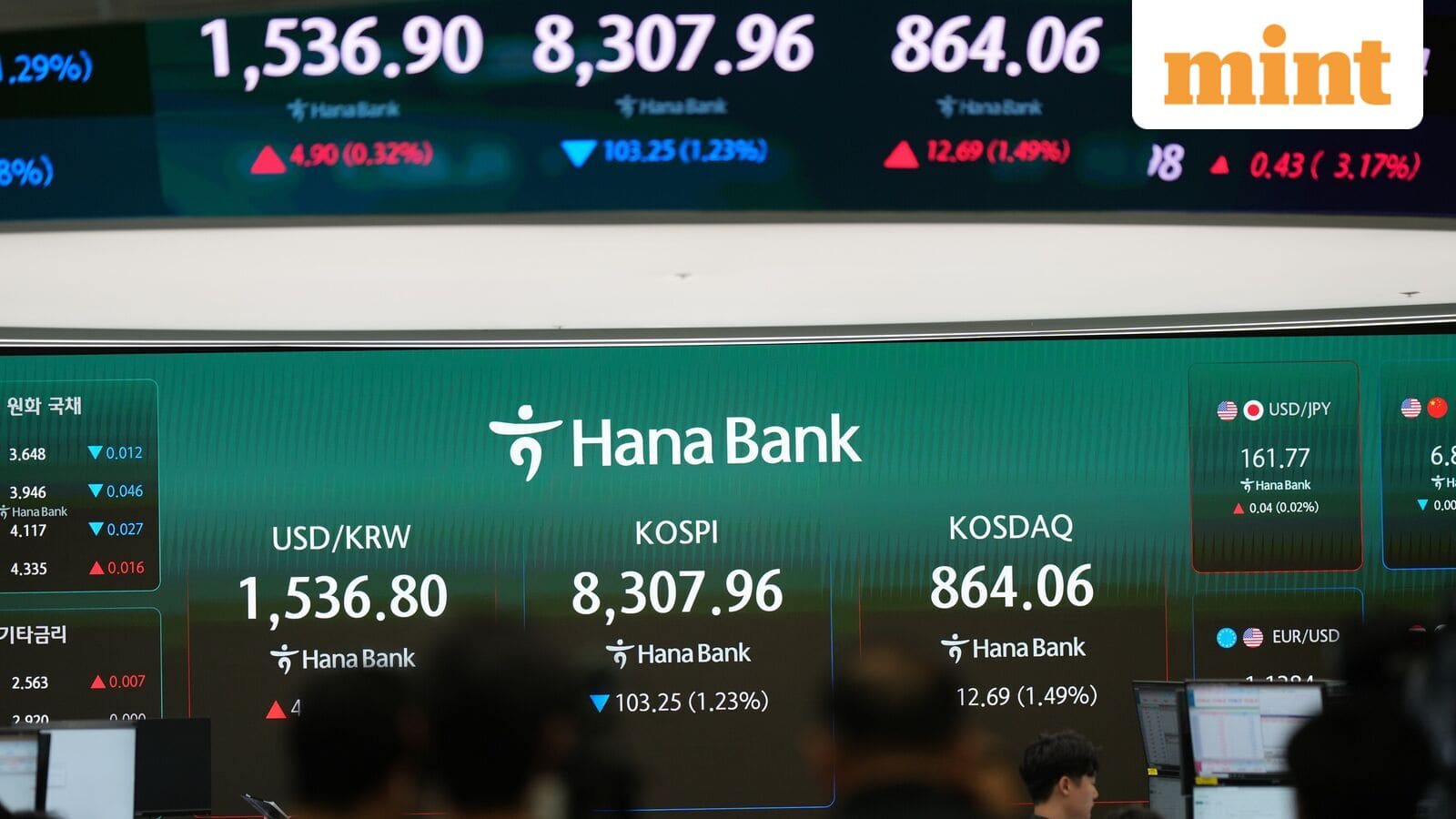
Asian equity markets opened lower on Monday as investors digested fresh hostilities in the Middle East. Japan's Nikkei 225 declined 0.98% and the Topix shed 0.21% in early trading. South Korea's Kospi fell 1.23%, though the Kosdaq bucked the trend with a 0.97% rally. Hong Kong's Hang Seng index futures pointed toward a higher open, diverging from the broader regional weakness.
The sell-off followed a mixed Friday session on Wall Street, where technology stocks dragged major indices lower. The Dow Jones Industrial Average slipped 0.09% to 51,876.11, the S&P 500 eased 0.05% to 7,353.95, and the Nasdaq closed 0.24% lower at 25,297.62. For the week, the S&P 500 dropped 2.05% and the Nasdaq tumbled 4.7%, driven largely by weakness in semiconductor and artificial intelligence-related names.
Nvidia fell 1.64%, AMD declined 2.06%, and Broadcom shed 3.67%. Micron Technology posted the steepest loss, plunging 6.69%. Gains in Microsoft, which jumped 5.71%, and Apple, which rallied 3.14%, provided only partial offsets.
Middle East Conflict Resurfaces
Renewed attacks between the United States and Iran over the weekend have rekindled concerns about supply disruptions and regional stability. Both nations exchanged strikes and accused each other of violating a ceasefire that had been in place ahead of scheduled peace talks this week. Discussions are expected to address the Strait of Hormuz and other flashpoints in an effort to de-escalate the conflict.
Crude oil prices climbed in response to the hostilities. Brent crude futures rose 0.67% to $72.51 per barrel, while US West Texas Intermediate gained 1.03% to $69.94. Energy markets remain sensitive to any developments that could threaten flows through critical shipping routes.
Gold prices, often a haven during geopolitical uncertainty, slipped on expectations of US Federal Reserve interest rate increases. Spot gold fell 0.5% to $4,067.99 per ounce, and US gold futures for August delivery declined 0.4% to $4,081.20. Spot silver lost 1.1% to $58.49 per ounce.
US Consumer Sentiment Shows Modest Recovery
Data released Friday showed US consumer sentiment rebounded from record lows in June. The University of Michigan's Consumer Sentiment Index rose to a final reading of 49.5 this month, up from 44.8 in May and slightly above the preliminary estimate of 48.9. Economists surveyed had forecast a final reading of 50.0.
The improvement, though modest, suggests households are adjusting to elevated inflation and interest rates. However, sentiment remains well below historical averages, reflecting ongoing concerns about the cost of living and economic uncertainty.
Goldman Sachs Lifts India GDP Forecast
Goldman Sachs upgraded its macroeconomic outlook for India in 2026, citing improved prospects following recent diplomatic progress. The investment bank now projects real GDP growth of 6.5% for the current fiscal year, up from an earlier estimate of 6.1%. The revision also includes lower forecasts for inflation and the current account deficit, reflecting expectations of moderating energy prices and stronger external balances.
The upgrade adds to a constructive view on India's economic trajectory, though near-term equity market performance will hinge on multiple factors. Ajit Mishra, Senior Vice President of Research at Religare Broking, noted that while the broader trend remains positive, traders should exercise caution. He emphasized the importance of disciplined risk management and avoiding excessive leverage, adding that sustained foreign institutional investor participation, continued moderation in crude oil prices, and global market stability will be critical for the durability of the next rally phase.
Week Ahead: Trade Talks and FPI Flows in Focus
Market participants will monitor several key triggers this week, including developments in US-Iran peace negotiations and progress on an India-US trade agreement. Foreign portfolio investor flows, crude oil price trends, and domestic and global macroeconomic data releases will also shape sentiment.
The interplay of geopolitical risk and economic fundamentals will test investor appetite for risk assets across Asia. For Mumbai, the ability to absorb external shocks while maintaining FPI inflows will be a key determinant of near-term direction.
RELATED STORIES

Indian Equities Push Higher Before Long Weekend as Policy Support Offsets Global Headwinds
Rajesh K. Iyer · 6 min
Indian Benchmarks Hold Above Key Thresholds as Oil Prices Retreat
Priyanka V. Rao · 3 min
Aditya Infotech Valuation Hits 47x After 427% Rally, Market Share Claims Draw Scrutiny
Priyanka V. Rao · 4 min

ICICI Bank Leads Value Gains as India's Top Banks Weather Mixed Week
Priyanka V. Rao · 4 min
Spot something wrong? Email editor@briefasia.com. We log every correction publicly.